Subsidence claims surge as homeowners face long repair waits
Subsidence claims are rising sharply at some insurers, while affected homeowners describe worsening damage, delayed inspections and uncertainty over repairs and the cost of future cover.
What happened
Subsidence claims increased sharply at some UK insurers over summer 2026, with homeowners reporting delays while damage continued to develop. Hastings told the Guardian that August brought its highest number of subsidence claims, 140% above August 2025, while its claims for 2026 to that point were up 30% year on year. The report, published on 12 September 2026, also described households waiting for inspections and repair plans.
The financial cost per claim has risen too, according to the Association of British Insurers (ABI). It said the average UK subsidence claim reached a record £20,000 between April and June 2026, more than £2,000 above the equivalent period in 2025. Insurers paid £72m for domestic subsidence claims during that quarter, compared with £60m a year earlier; separate coverage examines UK subsidence payouts and London risk projections.
Henry Biggs, 49, told the Guardian that cracks appeared in his family home in Stroud, Gloucestershire, in June 2025, a few months after he and his partner bought it. Admiral accepted their subsidence claim in spring 2026, but monitoring equipment was fitted only shortly before September’s report, roughly a year after they submitted the claim. At the time of publication, the couple still did not know when repairs would begin.
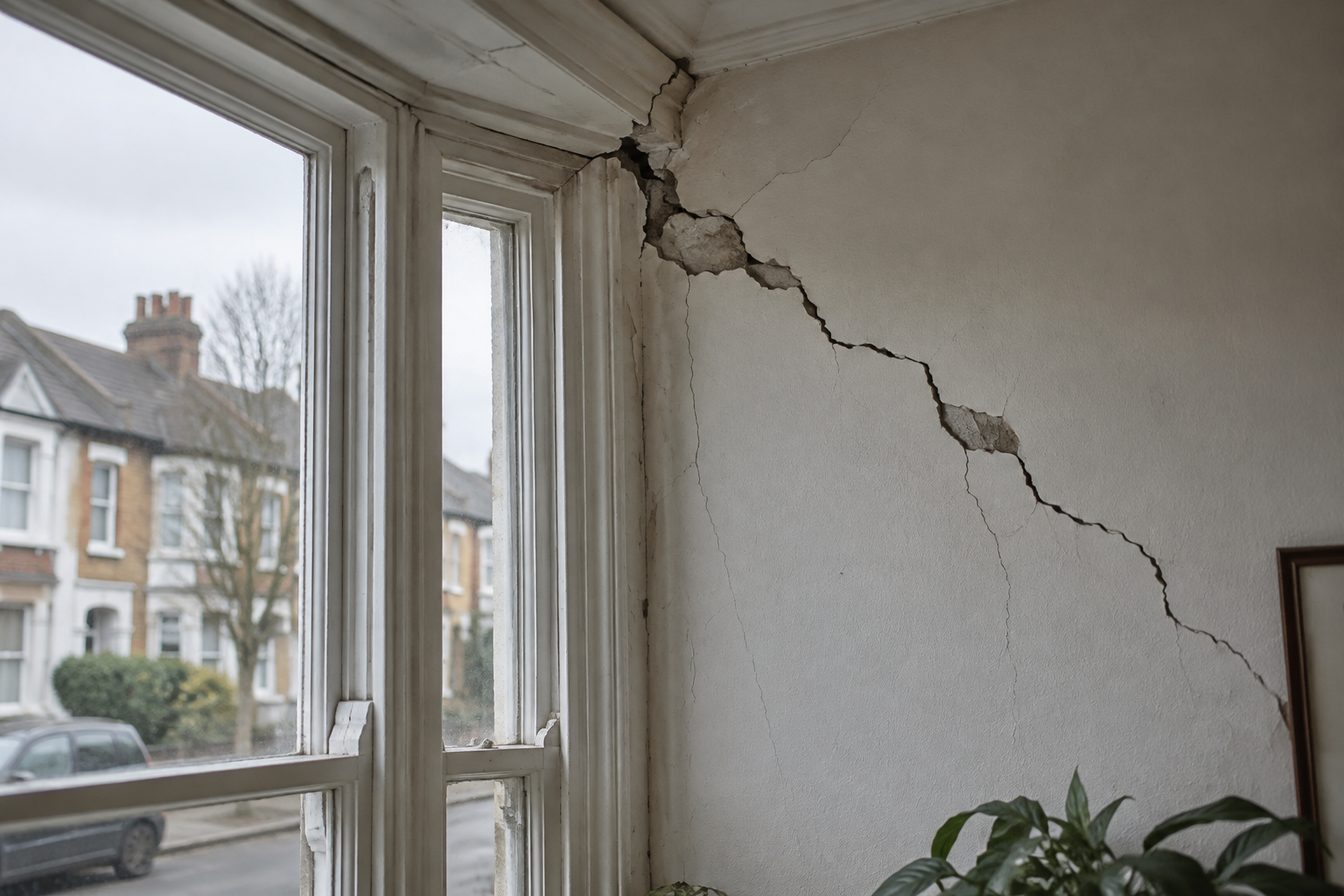
Biggs said damage to the house, built in 1970, became progressively worse during the 2026 heatwaves. He described cracks around windows, dropped door lintels and floors sinking and splitting across the kitchen, dining room and hallway. The couple had appointed their own loss assessor, according to the report, as they faced a claims process that can take several years.
The background
The British Geological Survey has warned that changing climate conditions could expose millions of homes to subsidence risk. Its worst-case scenario suggests 11% of UK homes, more than 4.2 million properties, could be at risk by 2070. That is a projection of exposure rather than a finding that each property will suffer damage, a distinction explored in why area-level subsidence figures are not a verdict on individual homes.
Scientists cited in the Guardian’s report identified clay-rich ground and older buildings with shallow foundations as particular vulnerabilities. As soil dries and contracts, movement beneath a building can pull its foundations down; hotter, drier summers and warmer, wetter winters can increase the problem. Areas identified as vulnerable include London, Essex and Kent, alongside a belt running from Oxford towards the Wash on England’s east coast.
Timothy Farewell, a geospatial environmental data scientist whose company MapleSky advises 20 insurers as well as water companies, said uneven movement is central to the damage. A building spanning two soil types can move differently on each side if one soil contracts more than the other. He said trees can also create uneven drying by drawing moisture from ground on one side of a house.
Farewell identified widespread soil drying in 2018, 2022, 2025 and 2026, linking those periods to damage affecting homes, water mains and roads. He said older water pipes can fail before houses show damage, making summer network failures a possible indication of increasing local subsidence risk. Peat-rich soils affect fewer homes, he added, but their movement can cause substantial problems for rural roads and pipe networks.
Read moreHome insurance after flooding costs £239 more a year in comparison study
What people are saying
Axa described 2026 as a year of unusually high subsidence activity, while Aviva said it was reviewing its reserves and pricing models, according to the Guardian. Shaune Worrall, deputy head of insurance at the British Insurance Brokers’ Association, warned that insurers were handling fresh claims while many from 2025 remained open. His concern was therefore about overlapping workloads, rather than simply the number of new cases arriving.
Melissa, a homeowner identified only by her first name, said she and her husband submitted a claim in August for their 1901 house in Walthamstow, London. After returning from holiday towards the end of that month, they found some cracks had widened beyond 1cm and their front door had become difficult to operate. By the September report, a structural engineer had not visited and the cause of the damage remained unconfirmed.
Rachel Hogarth Smith, 58, told the Guardian she had delayed claiming for damage at her late Victorian or Edwardian home after her insurer warned of possible consequences for future cover. She described sticking bay windows and a gap beneath the bay through which daylight was visible. A structural engineer had advised her to postpone repairs until spring and remove a nearby olive tree because of its effect on soil moisture.
The homeowners’ concerns extended beyond the immediate building work. Melissa said she had been warned that registering a subsidence claim could affect future insurance options even if investigations found another cause, while several other owners told the Guardian they feared higher premiums or difficulty obtaining cover. These were accounts of warnings and concerns, not evidence that every claim will produce the same insurance outcome.
What happens next
The next stage for affected households depends on their individual investigation and claim. At the time of reporting, Biggs’s home had reached the monitoring stage, while Melissa was still waiting for an engineering inspection; neither account established a repair timetable. The Guardian reported that increased claims were delaying inspections and that insurers were indicating waits of months before remedial work, so those September accounts should not be treated as updates on the households’ position in October.
The cost borne directly by a policyholder can also be substantial. The Guardian reported that subsidence excesses commonly exceed £1,000 and can reach £10,000 for properties with a previous subsidence history, even after underpinning; an excess is the part of an insured claim the policyholder pays. Owners considering letting their home also need to distinguish their building’s condition from whether their policy covers its use, as explained in insurance checks before letting a former home.
Worrall said the layout of a property can influence how extensive structural repairs need to be. Open-plan extensions, larger kitchens and connected living spaces can complicate the work, so the potential repair burden is not explained by soil conditions alone. For newer construction, Richard Smith, head of standards, innovation and research at the National House Building Council, said the organisation was considering whether its standards needed changing; the report did not identify a confirmed revision.
Sarah Dodd, founder of the law firm Tree Law, offered a different perspective on the longer-term outlook after repairs. Across roughly 25 years of handling tree-related subsidence disputes, she said she could recall fewer than 10 cases in which substantial subsidence returned after underpinning. That experience concerns the legal cases she encountered, rather than a national recurrence rate or a guarantee about the outcome for any particular home.
Why this matters
For homeowners, the reported increase in subsidence claims brings two separate uncertainties: how long investigations and repairs may take, and what future insurance could cost. The ABI’s £20,000 average claim is not a household’s expected bill, but reported excesses show that owners can still face substantial costs themselves. For buyers, regional risk projections provide context rather than a diagnosis; the condition and claims history of the individual property remain distinct questions.
Your questions answered
+Are subsidence claims rising in the UK?
Some insurers reported sharp increases in summer 2026. Hastings said August claims were 140% above August 2025, while its 2026 claims to that point were up 30% year on year. Those figures describe Hastings, not the whole market.
+How much does an average subsidence claim cost?
The ABI said the average UK subsidence claim reached a record £20,000 between April and June 2026. That was more than £2,000 higher than a year earlier.
+What are the signs of subsidence?
The report identified widening diagonal cracks, particularly around windows and doors, sloping floors and sticking windows or doors. These signs do not establish the cause on their own: one homeowner’s damage was still awaiting an engineering assessment.
+How long do subsidence insurance claims take?
The Guardian reported that complex claims can last several years. Henry Biggs said monitoring equipment was fitted roughly a year after his claim was submitted, and he still lacked a repair date when interviewed in September 2026.
+How much is a subsidence insurance excess?
The Guardian reported that excesses above £1,000 had become common. For a property with previous subsidence, the excess could reach £10,000, even after underpinning. These figures are not a quote for an individual policy.
+Will a subsidence claim affect my future home insurance?
Homeowners told the Guardian they had been warned about possible higher premiums or reduced choice of insurers. The report did not establish that every claim leads to those outcomes, or quantify any likely increase.
+Which areas are most at risk of subsidence?
Scientists cited in the report identified London, Essex, Kent and a belt from Oxford towards the Wash as vulnerable areas. Clay-rich soils and shallow foundations increase exposure, but an area-level projection does not determine an individual home’s condition.
+Does underpinning stop subsidence coming back?
Tree Law founder Sarah Dodd recalled fewer than 10 cases of substantial recurrence after underpinning in roughly 25 years of tree-related subsidence disputes. Her experience is not a national failure rate or a guarantee for a specific property.
This story draws on reporting first published by The Guardian.

Priya Raman, Environment & Homes Reporter
Priya reports on how weather and climate affect British homes, from flooding to drought-driven subsidence. She trained at Cardiff University's school of journalism and has covered environment stories across Wales and the South West.