UK subsidence payouts reach £307m as London risk projections rise
UK subsidence payouts reached a record £307 million in 2025, while new geological projections underline why buyers need to look beyond a property's postcode.
What happened
UK subsidence payouts reached £307 million in 2025, the largest annual total recorded by the Association of British Insurers (ABI), according to figures reported by Insurance Business on 25 September 2026. Alongside that claims bill, British Geological Survey (BGS) projections point to growing exposure in London. For buyers and owners, the distinction matters: insurance payments measure damage already claimed, while modelling describes potential future risk.
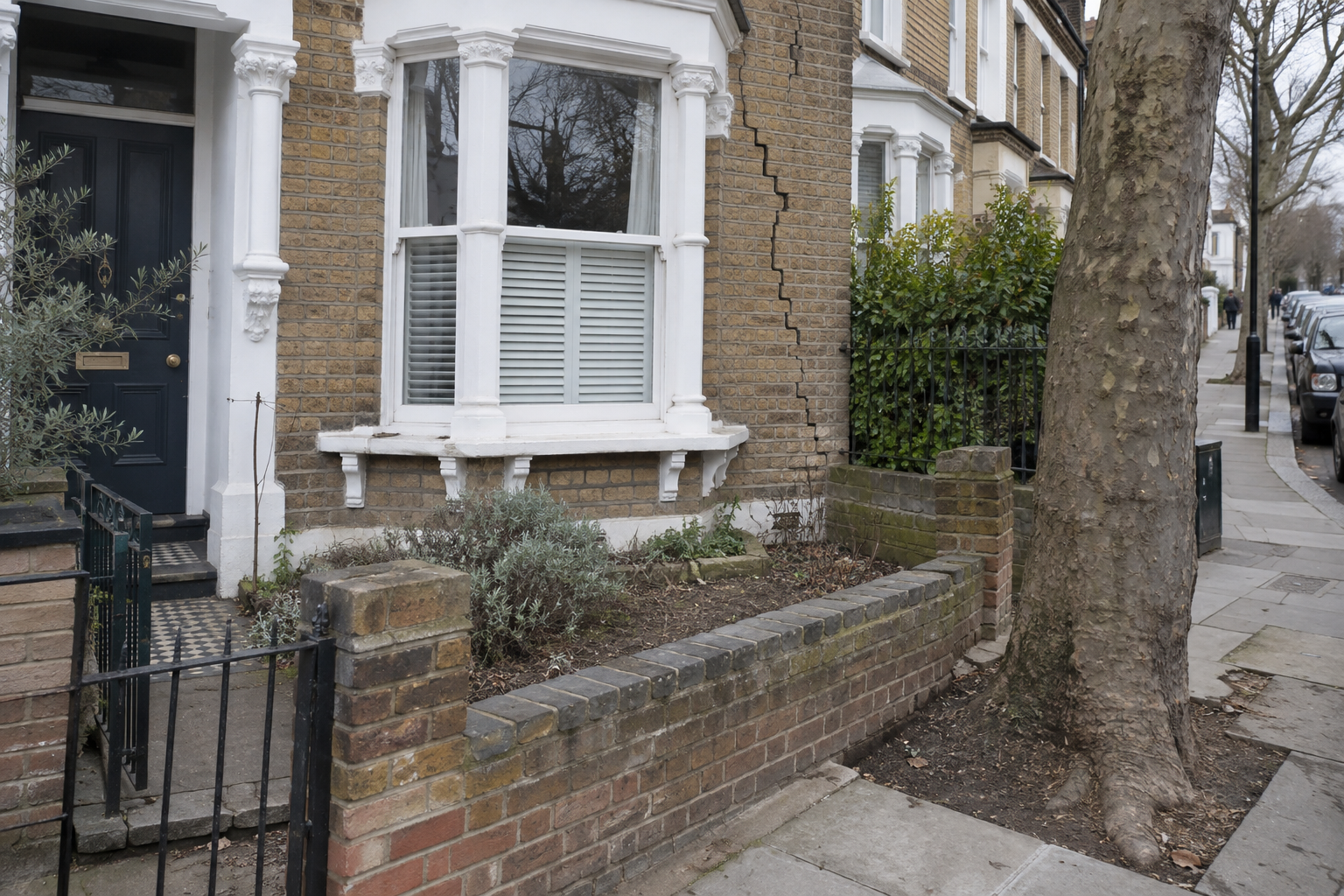
Insurance Business linked the record payouts to ground drying during what it described as the UK's hottest and driest spring on record, followed by further drying over summer. The concern centres on clay soils, which change volume as their moisture content changes. BGS identifies this shrink-swell process as a particular risk in parts of London and the South East.
Under a medium-emissions scenario, BGS projects that more than a quarter of London properties will fall into categories where shrink-swell subsidence is highly or extremely likely by 2070. Under higher emissions, the proportion exceeds half. Insurance Business also reported that more than 2.5 million properties in the capital already sit in a higher-risk category.
The ABI figures put the subsidence bill within a wider increase in weather-related losses. Weather-related property claims reached £1.2 billion in 2025, up 14% on 2024, while the total UK property claims bill reached £6.1 billion. Those totals describe different groups of claims and should not be treated as separate amounts to add together.
The BGS research highlighted by Insurance Business names Camden, Islington and Barnet among the London boroughs with concentrated exposure, alongside Kent. That geographical pattern is not a finding that every home in those areas has suffered damage. The research also considers local conditions and building characteristics, making a broad location only part of the assessment.
The background
BGS describes shrink-swell subsidence as a process in which clay expands and contracts with changing moisture levels. Its modelling takes account of geology, nearby trees, building age, drainage and the number of storeys. According to the report, those differences mean neighbouring properties can have materially different risk profiles despite sharing a street or postcode.
The emissions scenarios are an important qualification to the London projections. BGS presents different outcomes for 2070 depending on the scenario used, rather than a single unconditional forecast. The figures therefore should not be read as a timetable for damage to a particular house, or as an estimate of how many insurance claims will be made.
Flooding is a separate hazard with a wider national footprint in the Environment Agency's updated assessment. It places 6.3 million homes and businesses in England in areas exposed to flooding from rivers, the sea or surface water, rising to around eight million by mid-century. The count includes businesses as well as homes and covers England, not the whole UK.
The Environment Agency assessment identifies surface water as the largest source of flood risk, according to Insurance Business. This concerns intense rainfall overwhelming local drainage rather than only water spilling from a river or reaching land from the sea. The question of how buyers receive property-level information is also explored in the proposed Flood Performance Certificate trials in England.
Coastal erosion involves another mechanism: the loss of land supporting or surrounding a property. Insurance Business reported average erosion of several metres a year along parts of the East Riding of Yorkshire coast, including Holderness, with individual losses of at least 20 metres in some undefended locations. Those figures describe particular stretches of coastline, not a uniform rate for all coastal homes.
Read moreHome insurance after flooding costs £239 more a year in comparison study
What people are saying
The ABI's figures show that the rising cost of damage extends beyond subsidence. Storm damage payments for homes reached £244 million in 2025, an increase of 32% on the previous year, with the average payout reaching £2,450. Average homeowner flood payouts rose by 60% to £30,000, according to the same reporting of ABI data.
The premium figures moved differently over that period. The ABI recorded an average combined buildings and contents premium of £379 in the final quarter of 2025, £14 below the corresponding period a year earlier. That national average does not establish the price or availability of cover for an individual home with known ground movement or flood exposure.
BGS's approach, as described by Insurance Business, places weight on the interaction between ground conditions and the property itself. It supports looking more closely than a borough-wide label when considering exposure. The published account does not provide a property-by-property list that readers could use to confirm the condition of their own building.
The Environment Agency's updated assessment uses more detailed climate modelling than earlier versions, according to Insurance Business. Its emphasis on surface water broadens the issue beyond homes beside rivers or the coast. However, the assessment's national totals alone cannot tell a buyer whether a particular building has flooded or what an insurer would charge to cover it.
North Norfolk District Council provides an example of coastal risk already requiring action rather than remaining a projection. In April 2026, the council confirmed that three homes and a former office building in Happisburgh had been demolished because of erosion, according to Insurance Business. The report also says updated coastal projections allow assessments extending to 2055 and 2105.
What happens next
The BGS findings set out long-term scenarios, not a new deadline for homeowners to carry out work. The source report does not announce a change to insurance rules or a new obligation on sellers. Readers should therefore separate the increased visibility of risk from any claim that the projections themselves require immediate repairs or make a home uninsurable.
For a buyer, the practical questions are property-specific: has movement been investigated, is there a repair history, and what insurance terms are available? These are questions to raise with the seller, surveyor and insurer rather than answers supplied by a regional map. Keeping that evidence organised can sit alongside the wider checks needed during conveyancing.
Existing owners concerned about movement can ask their insurer what evidence it needs and whether an assessment is appropriate. A BGS risk category should not be treated as a diagnosis or used on its own to decide on structural work. The source gives no basis for prescribing the same remedy to every home in a higher-risk area.
Owners planning to rent out a former home should also check that their cover matches its intended use, rather than relying on the national premium average. The broader questions are covered in these insurance checks before becoming an accidental landlord. Neither the ABI totals nor the BGS projections establish what a particular landlord policy will cover.
Insurance Business argues that more detailed hazard information will increasingly influence premiums, policy availability and insurers' long-term decisions. It does not quantify future premium increases or identify properties that will lose access to cover. For an individual purchase or renewal, the available policy terms and evidence about the building remain more useful than assuming a national trend dictates the outcome.
Why this matters
The ABI's record payouts and BGS's projections make ground conditions an important consideration for buyers and owners, particularly in London and the South East. But neither a regional risk label nor a national claims total establishes what is happening beneath one home. The practical priority is to understand the building's history, seek appropriate assessment where there are concerns and check actual insurance terms. Flooding and coastal erosion require separate consideration rather than being treated as interchangeable threats.
Your questions answered
+How much did UK insurers pay for subsidence in 2025?
The Association of British Insurers recorded £307 million in domestic subsidence payouts in 2025, its highest annual total, according to Insurance Business.
+Which areas have the highest subsidence risk?
The BGS research highlighted in the report identifies concentrated shrink-swell exposure in London and the South East, including Camden, Islington, Barnet and Kent. Risk also depends on local ground conditions and building characteristics.
+Will half of London homes have subsidence by 2070?
That is not an unconditional prediction. Under higher emissions, BGS projects that more than half of London properties will fall into high or extreme shrink-swell likelihood categories by 2070. Under medium emissions, the proportion is more than a quarter.
+Why does dry weather increase subsidence risk?
BGS describes clay soils expanding and contracting as moisture levels change. Insurance Business linked the record 2025 subsidence payouts to spring and summer conditions that dried the ground.
+Can two houses on the same street have different subsidence risks?
Yes. According to the report, BGS modelling considers geology, nearby trees, building age, drainage and the number of storeys. Differences between neighbouring properties can therefore affect their risk profiles.
+Are home insurance premiums rising because of subsidence?
The report does not establish that for individual homes. ABI figures show the average combined buildings and contents premium fell £14 year on year to £379 in the final quarter of 2025, despite higher damage payouts.
+What should I ask before buying a house in a subsidence risk area?
Ask whether movement has been investigated, whether repairs have been carried out and what insurance terms are available. Discuss property-specific evidence with the seller, surveyor and insurer rather than treating a regional risk category as a diagnosis.
This story draws on reporting first published by Insurance Business.

David McAllister, Insurance Correspondent
David covers home insurance, premiums and claims. Based in Glasgow, he previously reported on financial services and has written extensively on subsidence and flood cover.