Subsidence payouts reach £297m as clay-soil risks affect homebuying
Subsidence payouts reached £297m by 2025, according to Groundsure, raising questions about insurance and property checks for buyers in areas with clay soils.
What happened
Subsidence payouts reached £297m by 2025 after rising around 90% over four years, according to environmental risk reporting company Groundsure. In an article published on 7 September 2026, the company highlighted the implications of ground movement for property transactions and insurance. Its warning concerns both the cost of existing damage and the assessment of future risk.
Groundsure also cited Association of British Insurers (ABI) figures showing £72m paid for domestic subsidence damage between April and June 2026. The average claim reached a record £20,000, more than £2,000 above the same period in 2025. Those quarterly figures cover a different period from the £297m figure and should not be read as interchangeable totals.
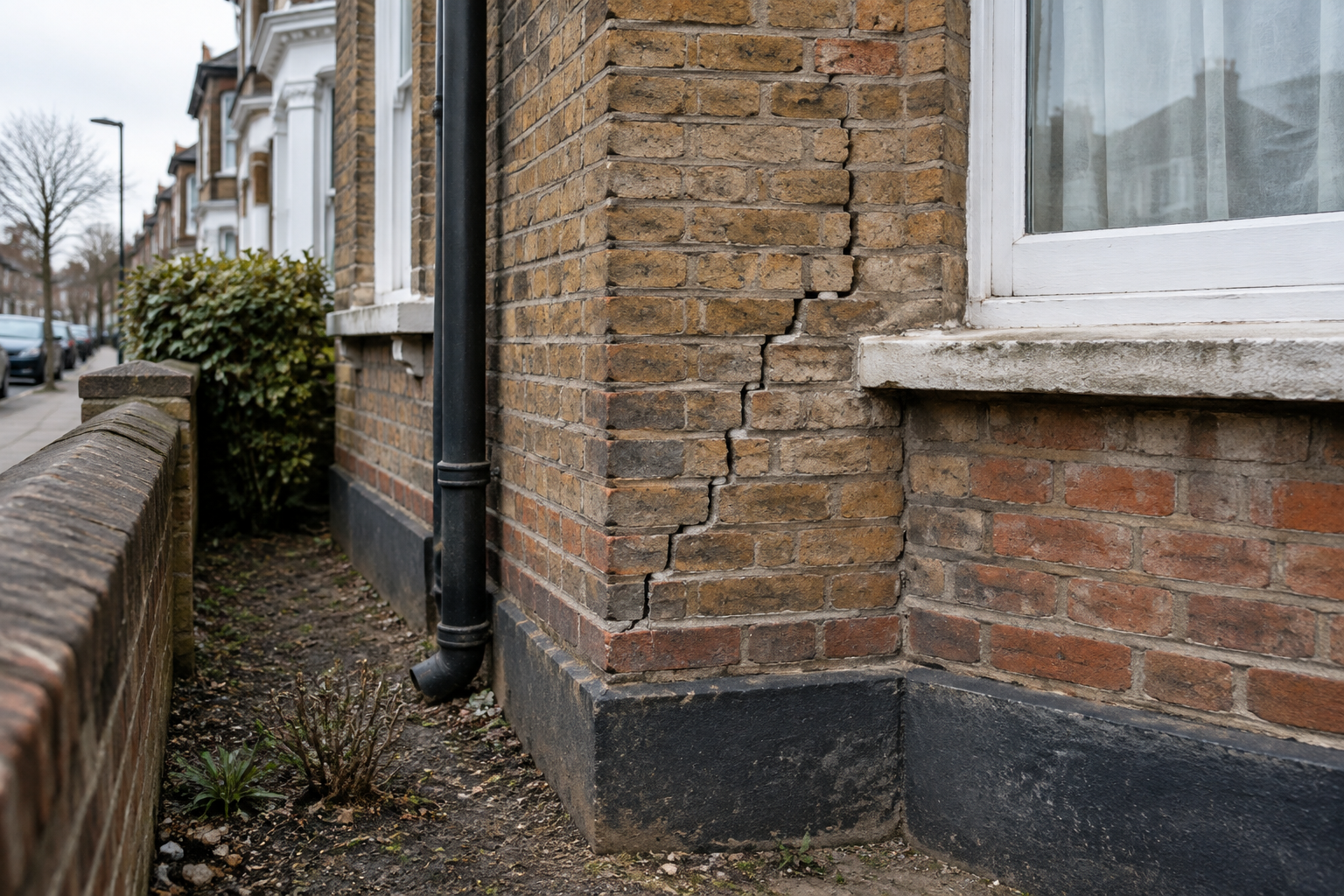
The company identified London, Essex, Kent and a wider area of eastern England as particularly exposed to movement in clay soils. It said Victorian and Edwardian homes founded in the upper layers of London clay can be especially vulnerable. That is a warning about particular ground and building conditions, rather than a finding that every older home in those areas has structural damage.
For buyers, Groundsure's central concern is that subsidence can affect more than the repair bill: it can also influence insurance, mortgageability and property value. The company sells environmental and climate-risk reports, so its assessment accompanies information about its own services. Its article does not provide a standard reduction in property value or a forecast for an individual household's insurance premium.
The background
Groundsure describes shrink-swell subsidence as a process driven by changes in soil moisture, particularly where the ground contains clay. During prolonged dry weather, clay loses water and contracts, potentially allowing the ground beneath a building to move downwards. The company links the recent pressure on homes to dry spring conditions and prolonged warm weather in 2026.
Rain can produce movement in the opposite direction when clay absorbs moisture and expands, Groundsure explains. Upward ground movement is known as heave, which is different from subsidence but can also damage structures. The company says repeated changes between dry and wet conditions can place continuing stress on buildings, rather than causing only a single episode of movement.
According to Groundsure, the effects can develop gradually and may involve foundations, underground services and other infrastructure. Small cracks or ground movement can be among the signs, although a crack alone does not establish its cause. The distinction matters when considering reports of damage alongside wider warnings about the susceptibility of the surrounding ground.
Groundsure says geology is only one part of a property's exposure. Its assessment approach also considers vegetation, nearby trees, drainage, building characteristics and age. That property-level focus is important when reading subsidence projections for larger areas, which cannot establish the condition of an individual house.
The company also warns that very dry ground can absorb intense rainfall less readily, increasing surface runoff. It cites figures highlighted by LexisNexis suggesting around 31% of flood claims occur in July and August, with more than 90% of summer flood claims involving surface water. These are flood figures, not subsidence statistics, but they explain why Groundsure considers the hazards together; the Environment Agency has separately warned about low awareness of flood risk in England.
Read moreHome insurance premiums averaged £391 in spring 2025, ABI figures show
What people are saying
Groundsure cites British Geological Survey (BGS) analysis as evidence that climate-related subsidence is already a concern for millions of homes. It identifies London and parts of the South East as areas where clay geology makes the issue particularly relevant. The account describes susceptibility to a hazard, not a tally of homes with confirmed subsidence claims.
For the longer term, Groundsure reports BGS modelling suggesting around 500,000 properties could be affected by 2070 under a low-emissions scenario aligned with the Paris climate agreement. Under a medium-emissions scenario, the figure exceeds 1.8 million. Groundsure describes that medium scenario as closest to current global emissions trajectories; neither figure is presented as an inevitable outcome.
The ABI evidence quoted by Groundsure concerns the financial cost of claims rather than those long-term geological projections. Its £20,000 average illustrates the size of subsidence losses in the reported quarter, but does not set a repair budget for a particular home. Likewise, the wider ABI figures on average home insurance premiums measure a different aspect of household insurance costs.
Groundsure says its GeoRisk reports combine geology with local and building-related factors to assess a property's susceptibility. Its ClimateIndex service uses geological information and climate projections from the BGS GeoClimate database to consider how exposure could change. The company says that forward-looking assessment also covers flooding and coastal erosion, rather than treating subsidence as the only relevant climate hazard.
Groundsure argues that conveyancers need to identify and assess subsidence risk during a transaction, while insurers must consider their exposure to claims. These are the company's stated priorities for the property and insurance sectors. Its article includes no individual homeowner testimony or new commitment from an insurer to change cover, prices or claims handling.
Adrian Hall, Chartered Engineer at Hall Davis Structural Engineers, said: “A past subsidence claim need not rule a house out. Buyers should ask what caused it, how it was repaired, and whether the property has been monitored since.”
What happens next
For a buyer considering a home in an affected area, the practical distinction is between potential ground movement and established damage. Environmental searches assess hazards, while a building survey examines the property's condition; neither should be treated as a substitute for the other. Groundsure's account supports looking at the specific site and building rather than relying solely on a county name or postcode.
For owners dealing with suspected movement, identifying the cause comes before deciding what repairs are appropriate. A buildings insurance policy's terms determine the available cover, exclusions and excess, rather than an industry-wide payout average. The separate LV= subsidence dispute involving a family's proposed rebuild illustrates why claims handling and the repair plan also matter to households.
The 2070 figures need to remain attached to their emissions assumptions when used in buying or ownership decisions. Groundsure's account does not provide a timetable for damage at a named property, or a probability that it will become uninsurable. Nor does it quantify how much a particular home might lose in value, despite identifying property values as a potential concern.
Groundsure says understanding present and future susceptibility will become increasingly important as climate conditions put pressure on clay soils. Its publication does not announce a new compulsory search, insurance rule or mortgage requirement. For households, the immediate issue is therefore the quality of information available about the property, rather than a newly introduced legal obligation.
Why this matters
Groundsure's figures highlight a potentially expensive risk, but national payouts cannot tell a homeowner whether their own building will move. For buyers in clay-soil areas, the useful questions concern the property's condition, local ground conditions and available insurance. Existing owners also need to distinguish a warning about future susceptibility from evidence of current damage. The emissions-based projections offer longer-term context, not a deadline for repairs or a prediction of an individual home's value.
Your questions answered
+How much have UK insurers paid out for subsidence?
Groundsure says subsidence payouts reached £297m by 2025, up around 90% over four years. It separately cites ABI figures showing £72m paid for domestic subsidence damage between April and June 2026.
+What is the average subsidence insurance claim?
ABI figures cited by Groundsure put the average at a record £20,000 between April and June 2026. That was more than £2,000 higher than a year earlier, but it is not an estimate for repairing an individual home.
+Why does hot weather cause subsidence?
Groundsure explains that prolonged dry weather can make clay soils lose moisture and shrink. Where this affects the ground supporting a building, it can cause downward movement and put stress on foundations.
+Which areas are most at risk of clay subsidence?
Groundsure identifies London, Essex, Kent and a broad area of eastern England as particularly vulnerable. Risk also depends on local geology, vegetation, drainage and building characteristics, so the area alone does not establish a home's condition.
+Are Victorian houses more vulnerable to subsidence?
Groundsure highlights Victorian and Edwardian homes built in the upper layers of London clay as particularly vulnerable. That does not mean every home of those ages has subsidence; site conditions and the individual building remain important.
+What is the difference between subsidence and heave?
Subsidence is downward ground movement. Heave is upward movement, which can happen when clay absorbs water and expands. Groundsure says both can place stress on buildings and underground services.
+Will 1.8 million homes have subsidence by 2070?
That is not a confirmed outcome. Groundsure cites BGS modelling suggesting more than 1.8 million properties could be affected under a medium-emissions scenario, compared with around 500,000 under a low-emissions scenario.
+Does a subsidence risk report replace a building survey?
No. Environmental risk reports assess hazards and susceptibility, while a building survey examines the property's condition. A warning about clay soils does not itself confirm structural damage.
This story draws on reporting first published by Groundsure.

Hannah Greaves, Legal Affairs Reporter
Hannah reports on leasehold reform, freehold rights and property law. She studied law at the University of Bristol before moving into journalism and follows legislation closely as it passes through Parliament.