Housebuilding output falls 4.7% as developers face funding strain
Housebuilding output fell 4.7% in the third quarter, according to the ONS, as industry figures warned that planning and funding pressures threaten future projects.
What happened
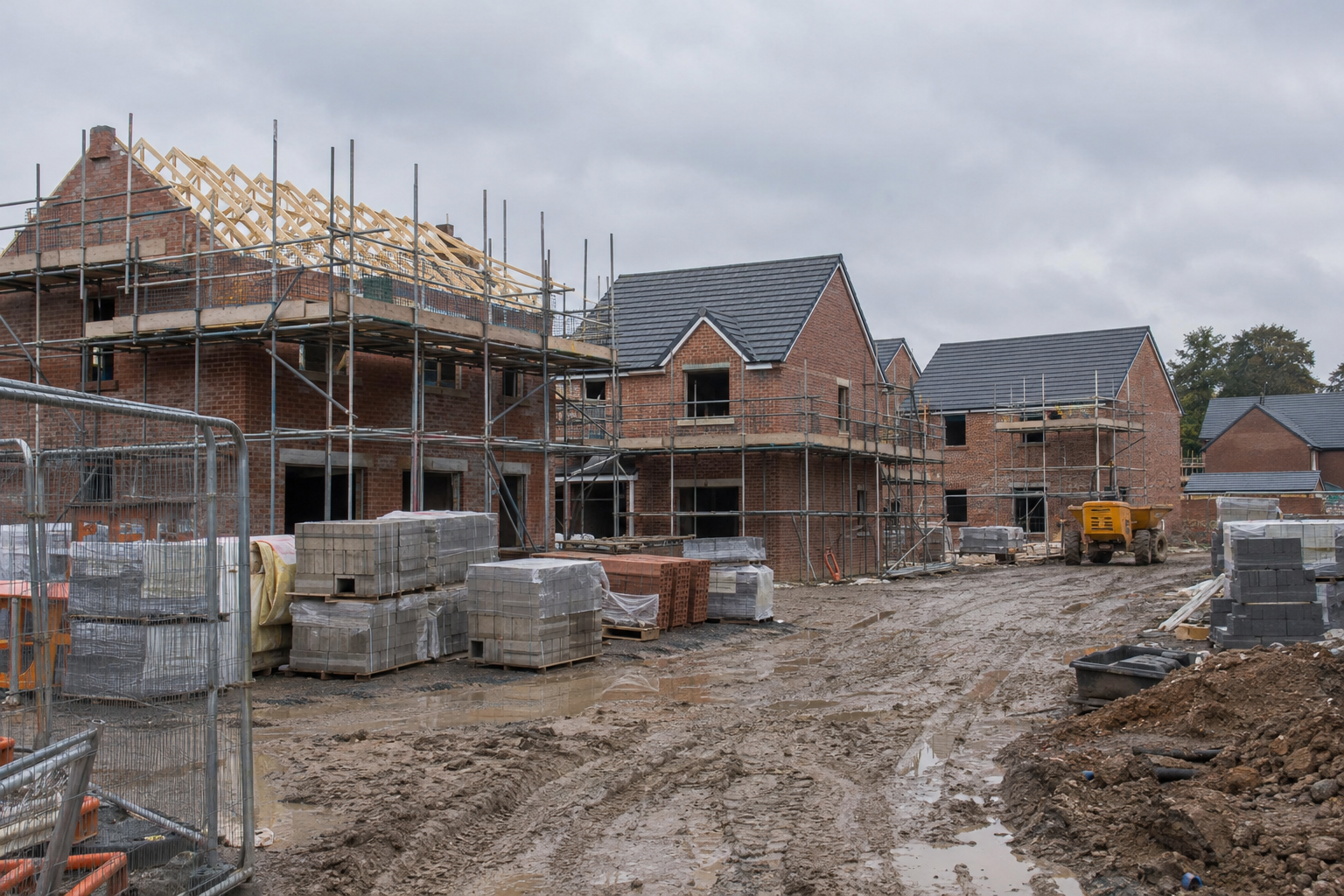
Housebuilding output in the private new housing sector fell 4.7% between July and September 2026 compared with the previous quarter, according to the Office for National Statistics (ONS). The sector made the largest downward contribution to a 0.7% fall in overall construction output. The figures put residential development at the centre of the quarterly construction slowdown.
The ONS figures showed declines in five of the nine construction sectors covered. Private new housing therefore weakened within a broader downturn, rather than accounting for the whole fall on its own. Its percentage decline was substantially larger than the reduction recorded across construction overall.
The figures measure output, not the number of completed homes. A 4.7% reduction in private new housing output should therefore not be presented as a matching fall in the number of properties available to buy. The comparison is also with the preceding quarter, not with the same three months in 2025.
For smaller developers, the concern extends beyond work already under way, according to Neil Leitch, managing director of development finance at Hampshire Trust Bank. He said the pressures behind the figures were making it harder for housebuilders to commit to subsequent projects. His warning concerns the future development pipeline as well as current activity.
Matthew Cook, managing partner at Goodman Jones, described a more difficult outlook for housebuilders and residential developers than for some other parts of construction. He identified infrastructure as an area offering grounds for cautious optimism. That distinction matters when assessing whether broader construction prospects reflect conditions facing companies building homes.
The background
Leitch pointed to research from Savills showing a sharp increase in applications for new homes without a corresponding increase in consents. He argued that this exposed a gap between planning reform and homes reaching delivery. No figures for those applications or permissions were included in his comments, so the scale of that gap cannot be quantified here.
Submitting a planning application and securing permission are separate stages of a development. Leitch said encouraging more proposals would achieve little if they subsequently stalled in the planning system. The distinction is also relevant to the separate issue of delays in decisions on planning conditions, which concerns requirements attached to permissions rather than simply the volume of applications.
Waiting for a decision can leave money committed to a scheme without certainty about its future, Leitch said. He argued that this was particularly damaging for small and medium-sized housebuilders because it limited their capacity to back other projects. In his assessment, the cost of delay is therefore not confined to the application that is waiting.
Leitch also identified slower sales, high financing costs and additional regulatory burdens as pressures falling disproportionately on smaller firms. He said these businesses lacked the financial resources available to major housebuilders. With margins already strained, he warned, a relatively small change in costs or circumstances could make a development no longer worth pursuing.
Cook added high material, energy and labour costs to the pressures facing developers, alongside subdued demand. His assessment brings together the expense of building homes and the difficulty of selling them. These are distinct from planning delays: a consent can allow a project to proceed without resolving whether its costs and expected sales make it financially viable.
Read moreYour First Home price caps set local limits for new-build buyers
What people are saying
Leitch said the output figures should prompt action on the conditions in which developers operate. His argument was that housing delivery would not improve sustainably through a higher number of applications alone. He placed the emphasis on viable developments receiving consent within statutory timescales and being capable of construction.
That position makes the handling of applications a central test of planning reform, rather than treating submissions as evidence of success. Leitch linked uncertainty directly to the ability of smaller housebuilders to keep investing. His comments suggest that progress needs to be judged at several stages, from permission through to a scheme being ready to build.
Cook pointed to interest rates as another constraint on residential development. He said the Bank of England’s decision on 5 November 2026 to increase Bank Rate from 3.75% to 4% added pressure through mortgage and development finance costs. He also raised the possibility of further increases, rather than presenting them as certain.
Cook warned that those financing pressures could weaken buyer confidence and undermine project viability. His assessment concerns both sides of a new-build transaction: the purchaser’s ability to fund a home and the developer’s ability to finance construction. It does not establish that every mortgage or development loan will change by the same amount.
Cook nevertheless acknowledged support in the Budget, citing an additional £1.5bn for the Social and Affordable Homes Programme and £4.7bn for Your First Home. The former sits within the wider announcement on social housing funding and council homes. He cautioned that the measures were unlikely to make a meaningful difference before 2027, leaving little immediate relief.
What happens next
The next test identified by Leitch is whether more proposed developments secure timely consent and remain viable enough to proceed. A rise in applications would not, on his reasoning, answer that question by itself. Evidence of permissions and subsequent building activity would be needed to show that the bottleneck he described was easing.
For smaller housebuilders, Leitch’s warning makes the availability of money for future projects particularly important. If capital remains committed to delayed schemes, their capacity to take on new work may remain constrained. That is a risk he identified, not a forecast giving a specific number of homes that will be lost.
Cook’s assessment places the likely benefits of the Budget measures beyond the immediate period covered by the figures. For prospective purchasers considering Your First Home, the scheme’s local price caps for new-build buyers are a separate practical issue from the overall funding allocation. An announced funding total does not by itself explain which homes a buyer can purchase.
The timing of demand also matters to developers deciding when to start work. Separate reporting on Bellway’s Your First Home outlook examines its expectation of more building alongside a warning that buyers may wait. That company-level outlook is distinct from the ONS figures, which describe activity already recorded across the sector.
For buyers considering a particular development, the national output figures cannot establish whether that site will be delayed or when an individual home will be finished. Nor do the figures provide a house-price forecast. The practical distinction is between the sector-wide pressures described by Leitch and Cook and the permissions, funding and construction timetable of a specific scheme.
Why this matters
For buyers, the concern is not just weaker activity today but the risk of fewer projects moving forward, as Leitch warned. Planning permission alone does not resolve the sales and funding pressures identified by the industry commentators. Cook’s view that Budget support may not have a meaningful effect before 2027 also limits expectations of a quick improvement. The national figures provide useful context, but they cannot tell a purchaser whether a particular new-build home will be ready on time.
Your questions answered
+How much did housebuilding output fall in Q3 2026?
Private new housing output fell 4.7% compared with Q2 2026, according to the ONS. It was the largest downward contributor to the quarterly fall in total construction output.
+Did UK construction output fall in Q3 2026?
The ONS reported a 0.7% fall in total construction output between July and September 2026 compared with the previous quarter. Five of nine sectors recorded declines.
+Does lower housebuilding output mean fewer homes were completed?
Output and completed-home numbers are different measures. The reported 4.7% fall in private new housing output does not establish an equivalent percentage decline in completed homes.
+Why are smaller housebuilders under pressure?
Hampshire Trust Bank’s Neil Leitch cited planning uncertainty, slower sales, high financing costs and regulatory burdens. He said smaller developers had fewer financial resources than major housebuilders to absorb delays and rising costs.
+Are more planning applications leading to more permissions?
Leitch cited Savills research showing a sharp rise in applications for new homes without a corresponding increase in consents. His comments did not include figures quantifying that gap.
+When will Budget housing funding help developers?
Goodman Jones’ Matthew Cook said the additional £1.5bn for the Social and Affordable Homes Programme and £4.7bn for Your First Home were unlikely to have a meaningful impact before 2027.
+Will the housebuilding fall delay my new-build home?
The national figures cannot establish the timetable for an individual development. They describe sector-wide output, not the permissions, funding position or completion date of a particular home.
This story draws on reporting first published by Mortgage Strategy.

Hannah Greaves, Legal Affairs Reporter
Hannah reports on leasehold reform, freehold rights and property law. She studied law at the University of Bristol before moving into journalism and follows legislation closely as it passes through Parliament.