David Parr House blue plaque to honour Cambridge’s skilled Victorian workers
David Parr House in Cambridge is to receive a blue plaque recognising the craftsman who spent 40 years decorating his family’s modest terraced home.
What happened
David Parr House in Cambridge is to receive a blue plaque honouring the Victorian craftsman who decorated its rooms over four decades, according to the charity responsible for the property. The unveiling is scheduled for 8 February 2027. The date marks the anniversary of Parr signing the mortgage on the Gwydir Street house in 1886, connecting the commemoration directly to his purchase of the family home.
The David Parr House & Gallery charity is crowdfunding £6,000 for the project, according to the announcement reported by Guardian Heritage on 22 November 2026. The money is intended to cover a ceramic plaque by local artist David Stonehouse, a short film recording its production and an exhibition. The proposed work therefore extends beyond installing a marker on the building.
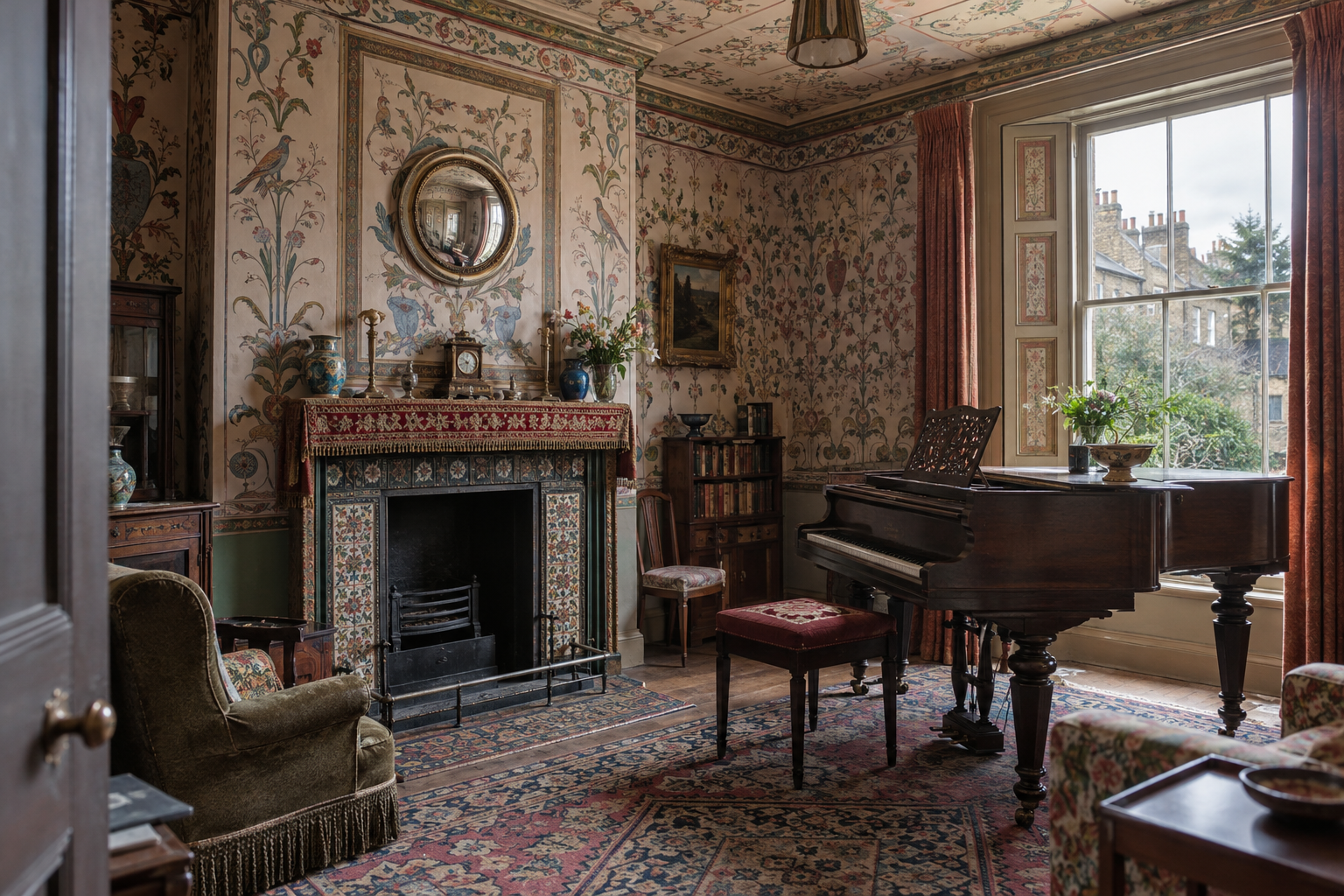
Parr earned his living decorating large private homes and Cambridge colleges, but used his spare time to develop his own designs at home, according to the account. He painted walls and ceilings, often working at night by candlelight. His rooms drew on the work of William Morris and George Bodley without simply reproducing the scale of the wealthy interiors where he worked.
The plaque is thought to be the first dedicated to a working-class Victorian decorative craftsman of this kind, the report said. That remains a qualified claim rather than a confirmed national first. The charity’s stated purpose is to recognise both Parr’s individual achievement and the contribution of skilled employees whose names rarely accompanied the celebrated designs they helped produce.
The background
Parr worked for FR Leach & Sons, a Cambridge decorative arts business, according to Annabelle Campbell, director of the David Parr House & Gallery charity. His apprenticeship gave him access to skilled work on significant decorative schemes. Campbell said his employment placed him among the craftspeople who translated the ideas of prominent Arts and Crafts designers into finished interiors.
Campbell explained that the Victorian term art-workman covered skilled painters, carvers and other craftspeople, generally employed by decorating firms. Their tasks required artistic judgement as well as precision, but recognition tended to favour the client, designer and company. In the records of Parr’s employment, she said, his contribution could be reduced to initials on a wage list or left unnamed altogether.
After Parr died in 1927, his granddaughter Elsie preserved the interiors throughout her lifetime, according to the report. The decoration remained largely unknown outside the home for more than 80 years. Its survival depended on the continuing care of a family member, rather than the property immediately becoming a museum or a publicly recognised memorial to its maker.
Social historian Tamsin Wimhurst encountered the house in 2009 when she knocked on the door of Elsie, then aged 93, the report said. Inside, she found the hand-painted rooms still intact. The charity subsequently acquired the property after Elsie’s death, and the house opened to visitors in 2019, bringing a previously private domestic interior into public view.
The wider heritage context includes other domestic interiors associated with design history, although their recognition takes different forms. Property Pulse UK has also reported on the Category A listing of Mackintosh House alongside Glasgow’s Hunterian Gallery. A commemorative plaque and statutory listing serve different purposes: the former marks an association, while the latter provides legal protection for a building’s special architectural or historic interest.
Read moreHeritage at risk register adds Hastings Castle and Dickens’ chalet
What people are saying
Campbell’s explanation places the emphasis on the people who physically carried out decorative work, rather than only those who supplied the designs. She said the plaque would recognise the importance of skilled workers to the Victorian decorative arts economy. In Parr’s case, the surviving family home provides evidence of his own ambitions as a maker, alongside the work he undertook for his employer.
She also described Parr’s decoration as a personal project for his family, not merely an extension of paid employment. According to Campbell, he wanted to create rooms with the beauty of those he decorated professionally, but within a much smaller home. That distinction matters to the charity’s account: the house records what Parr chose to make for himself, rather than a commission set by a wealthy client.
Campbell said the plaque would draw attention to the working-class history of Cambridge’s Mill Road area, where many houses were occupied by skilled Victorian artisans. She contrasted that history with existing city plaques celebrating prominent academics, including Bertrand Russell and John Maynard Keynes. Her argument is that the people commemorated in Cambridge should also reflect the crafts and trades that contributed to its cultural life.
The charity’s decision to commission a ceramic plaque reflects its interest in how objects are made, Campbell said. Recording Stonehouse’s work on film will make the production process part of the project rather than leaving only the finished object visible. The planned exhibition adds another way to explain the relationship between Parr’s craftsmanship, his home and the new commemoration.
What happens next
The next scheduled milestone is the plaque unveiling on 8 February 2027, according to the charity’s announcement. As reported on 22 November, fundraising for the £6,000 project was under way. The source did not state how much had already been raised, so it does not establish either a remaining shortfall or that the target has been reached.
Stonehouse has been commissioned to make the plaque, while the project also includes the film and exhibition, the report said. No separate completion or opening dates were given for those elements. The February date is therefore the announced unveiling date, not a confirmed timetable for every part of the wider programme.
For period-home owners, the practical distinction is between recognition and permission to alter a property. In England, a blue plaque does not itself impose listed-building controls; where a building is listed, works affecting its special interest can require listed-building consent. The source makes no announcement of a new listing decision for David Parr House, and the plaque should not be read as one.
Owners considering work to a listed home should establish the consent requirements before changing significant interiors or other historic features. That is a separate question from whether a person associated with the property is commemorated on its exterior. Property Pulse UK’s coverage of Historic England’s advice on listed-building energy upgrades explains why proposed improvements and heritage consent need to be considered together.
Recognition also differs from an assessment of a building’s condition or its repair needs. The Heritage at Risk register additions involving Hastings Castle and Dickens’ chalet concern a different aspect of heritage protection. For David Parr House, the announced fundraising is specifically for the plaque, film and exhibition; the source does not describe it as a building-repair appeal.
Why this matters
For owners and buyers of period homes, David Parr House shows why a modest exterior may reveal little about the significance of the rooms inside. According to the charity’s account, its interiors survived through decades of family care. The plaque will recognise that history, but commemoration is separate from legal protection. Anyone planning changes to a historic property should establish its listing status and any consent requirements rather than treating the presence or absence of a plaque as a guide.
Your questions answered
+Where is David Parr House?
David Parr House is on Gwydir Street in Cambridge. It is a modest Victorian terraced home containing hand-painted interiors created by the decorative craftsman David Parr.
+When will the David Parr House blue plaque be unveiled?
The unveiling is planned for 8 February 2027, according to the charity. The date marks the anniversary of Parr signing the mortgage on his home in 1886.
+Who was David Parr?
Parr was a Victorian decorative craftsman employed by Cambridge firm FR Leach & Sons. He worked on interiors for wealthy clients and colleges, while spending 40 years decorating his own family home.
+Did William Morris design David Parr House?
According to the report, Parr devised the decoration himself, drawing inspiration from William Morris and George Bodley. The home records his own creative work rather than a commission designed by Morris.
+How much is being raised for the David Parr plaque?
The charity’s crowdfunding target is £6,000. The project covers a ceramic plaque by David Stonehouse, a short film documenting its making and an exhibition.
+Who preserved David Parr House?
Parr’s granddaughter Elsie preserved the interiors after his death in 1927. Social historian Tamsin Wimhurst encountered the house in 2009, and it opened to the public in 2019.
+Does a blue plaque make a house a listed building?
No. A blue plaque commemorates an association; statutory listing provides legal protection for a building’s special interest. The announcement does not describe a new listing decision for David Parr House.
This story draws on reporting first published by Guardian Heritage.

Sophie Carrington, Homes & Renovation Writer
Sophie writes about extensions, loft conversions and renovation projects. A former homes magazine sub-editor, she has renovated two Victorian terraces herself and focuses on costs, permissions and avoiding common pitfalls.