England’s oldest pub: Somerset inn puts building evidence ahead of legend
England’s oldest pub is the George Inn in Somerset, according to archaeologist James Wright, whose findings show why historic property claims need more than an ancient date.
What happened
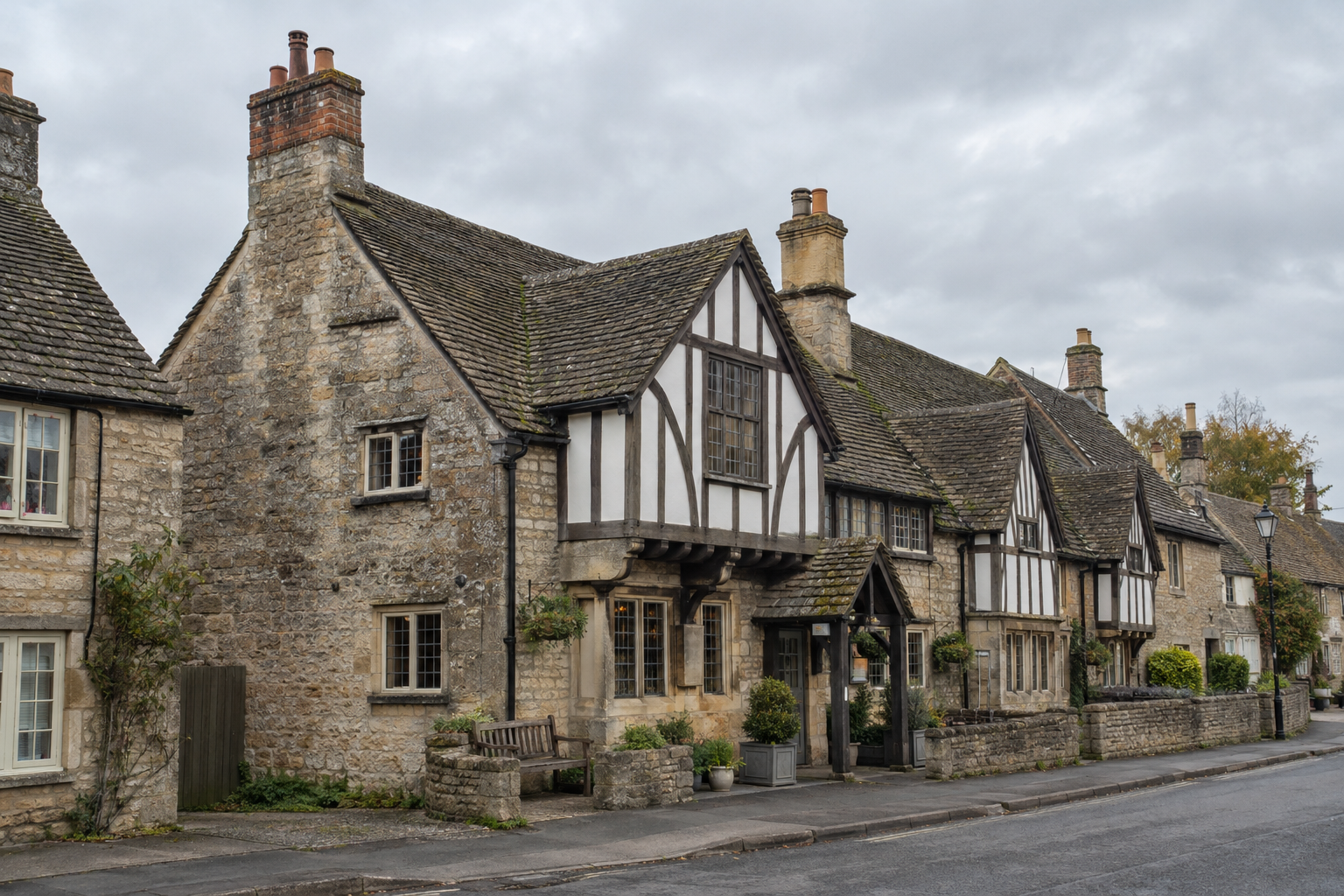
England’s oldest pub is the George Inn in Norton St Philip, Somerset, according to buildings archaeologist Dr James Wright. In findings reported by Guardian Heritage on 23 October 2026, he identified the inn through evidence about its construction and use. For buyers of historic property, the assessment highlights an important distinction: the age of a building is not necessarily the age of the business occupying it.
Wright dates surviving parts of the George Inn to the late 14th century and to 1430–1432. He says monks from nearby Hinton Priory established it in the 14th century, and that its architectural history supports more than 600 years of continuous service. The source report describes the inn as serving ale continuously since the early 1430s.
His assessment brings together archaeological investigation, documentary records and tree-ring dating, rather than relying on a claimed founding date. Wright looked for buildings constructed as public houses, with continuous use and substantial surviving material from their original construction. Those conditions make this a judgement about a surviving building and its history, not simply the earliest recorded activity on a site.
Wright, who has worked on behalf of Historic England, challenges the much earlier origins promoted by several other pubs. He says it is difficult to establish that buildings were constructed and used as inns or alehouses, and remained in that use, before the 1400s. His conclusion is an archaeological assessment; the report does not describe Historic England awarding an official oldest-pub title.
The background
Tree-ring dating, also called dendrochronology, was among the methods used in Wright’s investigations. It can help establish when structural timber was felled, providing evidence that is independent of a pub’s name or reputation. Wright explains that medieval carpenters generally built with freshly felled wood, so the felling date can closely indicate when construction took place.
That connection does not make every date attached to an old building interchangeable. Wright’s list gives some properties several dates or broad ranges, reflecting the evidence for their surviving fabric. The George Inn’s late-14th-century material and its 1430–1432 date therefore belong within a building history, rather than being reduced to a single year that supposedly explains every part of the property.
Wright also examined buildings that had been converted or had changed use at different times. Even allowing for those cases, he puts the number of credible pubs trading since medieval times at around 12 to 16. He dates the earliest contenders to the 14th and 15th centuries, substantially later than the Saxon-era origins claimed by some establishments.
His published list includes the Bull Hotel in Ludlow, Shropshire, with fabric from the 14th and 15th centuries, and the King’s Head in Shrewsbury, with dates of 1426 and 1430–1431. The New Inn in Gloucester is dated to 1432, while the White Hart Inn in Hook, Hampshire, has a range of 1419–1451. These entries show why one early timber date alone does not explain the overall ranking.
The distinction between age, surviving material and significance also matters when considering protected homes. Under England’s listed-building system, protection is not simply a statement that a property is old, and it can extend to interiors as well as the exterior. The listing of Barn Close and its Arts and Crafts interiors provides a separate example of the importance of features inside a historic house.
Read moreDoncaster Dome listed: what Grade II status protects
What people are saying
The competing positions concern what the pubs claim and what Wright says the evidence supports. Ye Olde Fighting Cocks in St Albans, Hertfordshire, promotes origins around AD800. Wright says its familiar AD793 date probably emerged on a postcard in 1926, while earlier suggestions had placed its beginnings in 1030, 770 and 672.
Wright offers a different account of that building: he says it began as a monastic dovecote around 1400. The earliest period in which he can securely establish its operation as a public house is the first decade of the 19th century. On that evidence, an old structure and a long-established pub are separate propositions, with different dates requiring different support.
The Bingley Arms in Bardsey, West Yorkshire, presents itself as Britain’s oldest pub, with origins more than 1,000 years ago. The Royal Standard in Beaconsfield, Buckinghamshire, associates its history with King Alfred the Great’s West Saxons around AD880. Wright argues that many such claims are more likely to reflect commercial promotion than reliable evidence about construction and continuous use.
He also rejects claims that pubs appear in the Domesday Book, saying it contains no pub references. That objection concerns the claimed historical evidence, not whether an establishment occupies an old settlement. The supplied report sets out the pubs’ promotional claims but includes no direct responses from their operators to Wright’s assessment.
Wright’s position places surviving fabric and documented use ahead of an impressive founding date. That is a different question from whether a building deserves statutory protection: England’s listing system recognises special architectural or historic interest, rather than awarding age records. The explanation of Grade II protection following the Doncaster Dome listing sets out that separate role.
What happens next
The source report gives no timetable for further testing or any formal process to resolve the rival claims. Wright’s list nevertheless identifies other buildings relevant to the debate, including the mid-15th-century George Hotel in Dorchester-on-Thames, Oxfordshire. He dates the Kings Head in Aylesbury, Buckinghamshire, to 1445–1455 and the Angel in Grantham, Lincolnshire, to about 1450.
Later entries in his assessment include the George and Pilgrims Inn in Glastonbury, Somerset, dated to 1461–1483, and the Saracen’s Head in Southwell, Nottinghamshire, dated to the 1460s. The George Hotel in Odiham, Hampshire, is dated to 1486–1487. These dates identify the buildings Wright considers credible medieval contenders; they do not support the much earlier origins promoted elsewhere.
For someone examining a period property’s history, Wright’s approach provides three useful questions: what was originally built, what survives, and how was it used? A dated beam can help answer the construction question without establishing every later use of the rooms around it. Documentary evidence and examination of the building therefore address different parts of the same history.
For owners planning alterations, historic dating and permission to carry out work remain separate matters. Under England’s listed-building rules, works affecting a listed building’s special character require listed building consent, and protection is not limited to the façade. The conservation-led repair of St Andrew’s Chapel offers a separate example of work on a historic building; Wright’s pub assessment itself announces no repair scheme, funding or change to planning rules.
Why this matters
For buyers and owners of period homes, Wright’s findings underline why a property’s advertised age needs supporting evidence. His assessment separates the date of surviving material from a building’s original purpose and later use. Those distinctions help readers understand what a historic claim actually establishes. For listed properties in England, age is also separate from the practical question of consent: alterations affecting special character require approval, regardless of any claim to be the oldest.
Your questions answered
+What is England’s oldest pub?
Buildings archaeologist Dr James Wright identifies the George Inn in Norton St Philip, Somerset. His assessment considers surviving early fabric, original purpose and continuous use, rather than relying only on a claimed founding date.
+How old is the George Inn in Norton St Philip?
Wright dates surviving parts to the late 14th century and 1430–1432. He says monks from Hinton Priory established the inn and that its architectural history supports more than 600 years of continuous service.
+How does tree-ring dating work on old buildings?
Tree-ring dating can help establish when structural timber was felled. Wright says medieval carpenters generally used freshly felled wood, making that date a close guide to construction.
+Is Ye Olde Fighting Cocks really from AD793?
Wright disputes that date and says it probably appeared on a postcard in 1926. He dates the building’s origins as a monastic dovecote to around 1400, with securely established pub use in the early 19th century.
+Are any pubs mentioned in the Domesday Book?
Wright says the Domesday Book contains no references to pubs. He rejects claims that an entry in it establishes a pub’s origins.
+Has Historic England officially named the oldest pub?
The source report presents Wright’s archaeological assessment and notes that he has worked on behalf of Historic England. It does not describe an official oldest-pub designation by the organisation.
+Does an old beam prove when a pub opened?
Not by itself. Wright’s method also considers the building’s original purpose, evidence of continuous use and surviving early material. A construction date and the start of pub trading can be different.
This story draws on reporting first published by Guardian Heritage.

Hannah Greaves, Legal Affairs Reporter
Hannah reports on leasehold reform, freehold rights and property law. She studied law at the University of Bristol before moving into journalism and follows legislation closely as it passes through Parliament.