Mackintosh House gains Category A protection alongside Glasgow gallery
Mackintosh House and the Hunterian Art Gallery have received Category A listing, recognising both reconstructed domestic interiors and the modern Glasgow building that houses them.
What happened
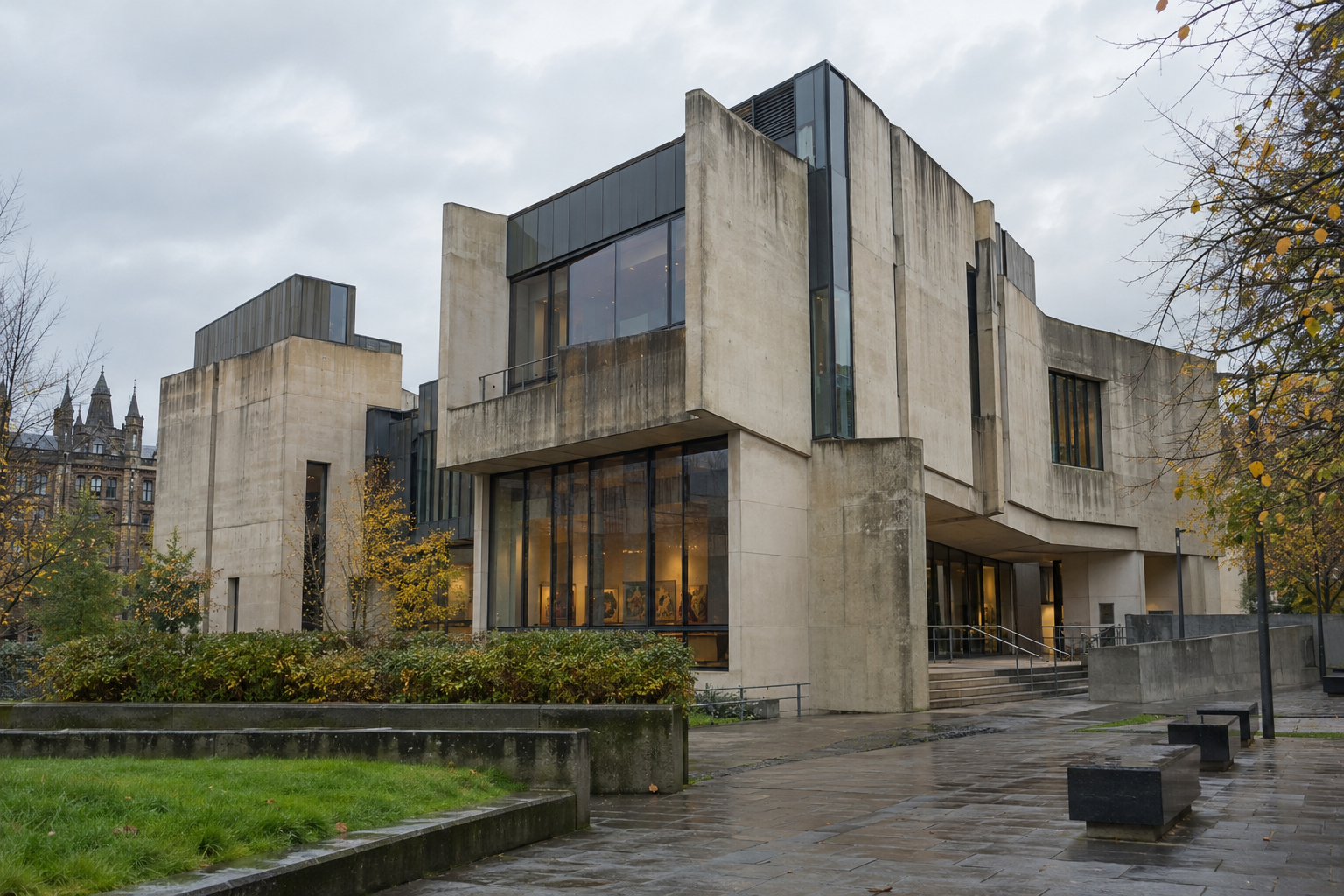
Mackintosh House and the Hunterian Art Gallery in Glasgow have been listed at Category A, Historic Environment Scotland (HES) has announced. The designation covers a university gallery containing partially reassembled interiors from the home of Charles Rennie Mackintosh and Margaret Macdonald Mackintosh. It recognises the building that accommodates those rooms as well as its connection with the two designers.
According to HES, architect William Whitfield designed the building for the University of Glasgow, with construction taking place between 1973 and 1978. The gallery houses the university’s art collection alongside the recreated domestic spaces. The listing therefore concerns a purpose-built cultural building, rather than the original house where the Mackintoshes lived.
HES identified three principal reasons for designation: the quality of Whitfield’s Brutalist architecture, the approach taken to reconstructing the home, and the building’s historical associations with the designers. Its decision gives architectural significance to the modern setting in its own right. The reconstructed interiors are one part of that assessment, not its sole justification.
The decision followed a public consultation, according to HES. The announcement supplied for this report does not give an exact designation date or set out the consultation responses. HES has directed readers to its designation portal for the listing information and report explaining how the decision was reached.
For period-home owners, the distinction between an original house and reconstructed interiors is important. HES’s decision shows that the significance of this building rests on several layers of architectural history. It is not simply recognition of old rooms: the assessment also values the later design used to preserve and present them.
The background
The interiors came from the Mackintoshes’ former home at 78 Southpark Avenue in Glasgow, according to HES. Before that house was demolished in 1963, the rooms were carefully recorded and material was salvaged. Those preparations made it possible to reassemble parts of the domestic interior in a different building.
HES describes Mackintosh House as a partial reassembly, rather than the survival of the original property. That distinction helps explain what visitors encounter: interiors brought together within the university gallery, not a house retained on its original site. The listing recognises the reconstruction as an important architectural undertaking in itself.
The Hunterian holds the largest single collection of work by Margaret Macdonald and Charles Rennie Mackintosh, according to the announcement. HES identifies both as designers whose influence extends across art, architecture and interiors. The recreated home sits alongside that wider collection, connecting their domestic surroundings with other examples of their work.
The institution is much older than Whitfield’s gallery building. According to the Hunterian’s background information, it opened at the University of Glasgow in 1807 following the bequest of Dr William Hunter. Its collections cover arts, sciences and humanities, and the collection as a whole has recognised national significance in Scotland.
The Hunterian also acknowledges that its collections developed through Glasgow’s connections with empire, transatlantic slavery, colonialism and migration. That institutional history is separate from the architectural case HES gives for listing the gallery. It provides context for the museum’s stated ambition to make its collections meaningful to a wider range of audiences.
Read moreParliament restoration: delays add £420m a year as MPs face choice over moving out
What people are saying
Dara Parsons, HES’s head of designations, emphasised the architectural importance of the gallery itself. Her response presented the building as a significant late-modernist cultural venue, while also recognising the way Mackintosh House preserves the designers’ legacy. That position places Whitfield’s work alongside the earlier interiors, rather than treating the gallery as a neutral container.
Professor Steph Scholten, director of the Hunterian, welcomed the Category A decision as recognition of the building’s architectural and cultural importance. He highlighted the combination of the art collections and the opportunity to explore the reassembled home interiors. His comments also placed the gallery within the University of Glasgow campus and Scotland’s wider cultural life.
The two organisations approached the decision from different responsibilities. HES explained the architectural and historic grounds for designation, while the Hunterian focused on the collections and visitor experience. Neither statement set out a new construction project, restoration budget or programme of alterations connected with the listing.
HES describes itself as Scotland’s lead body for the historic environment, with responsibilities including research, recording and care for more than 300 nationally important properties. Its designation role is distinct from an assessment of whether a building is in poor condition. The separate heritage-at-risk reporting on Hastings Castle and Dickens’ chalet concerns a different question: the threats facing historic places.
What happens next
The immediate reference point is the HES designation record and accompanying handling report. HES says these are available through its portal for readers who want the detailed reasoning behind the decision. The announcement itself does not provide a room-by-room account of the designation or a schedule of future works.
Under Scotland’s listed-building system, listing does not impose an automatic ban on change. Listed building consent is generally required for demolition, or alterations and extensions that affect a listed building’s character as a place of special architectural or historic interest. For a proposed project, the relevant planning authority is the starting point for checking those requirements.
Owners of other historic properties should not assume that protection concerns only a building’s exterior. Internal work can also affect its special character, so proposals need checking before work begins. The issues overlap with those explored in Historic England’s explanation of consent for listed-building energy upgrades, although that guidance concerns England rather than Scotland.
The designation announcement does not propose turning the gallery into housing or changing its use. That separates this decision from the practical questions examined in Historic England’s guide to bringing vacant buildings into residential use. Here, HES has recognised an existing cultural building; the source supplies no timetable for a further development scheme.
Why this matters
For owners and buyers of historic homes, the decision illustrates why a building’s significance cannot be judged from its age or façade alone. HES recognised both reconstructed domestic interiors and the later gallery designed around them. Scotland’s listed-building rules can also apply to internal alterations, making early checks important before renovation. This announcement concerns a university building, not a new restriction on surrounding homes, and it contains no proposal for a housing development.
Your questions answered
+Is Mackintosh House now a listed building?
Yes. Historic Environment Scotland has announced Category A listing for the Hunterian Art Gallery and Mackintosh House at the University of Glasgow.
+Is Mackintosh House the original Mackintosh home?
No. HES says it contains partially reassembled interiors from Charles Rennie Mackintosh and Margaret Macdonald Mackintosh’s former home at 78 Southpark Avenue. The original house was demolished in 1963.
+Why was Mackintosh House listed?
HES cited Whitfield’s Brutalist architecture, the approach to reconstructing the home interiors, and the building’s close historical association with Charles Rennie Mackintosh and Margaret Macdonald Mackintosh.
+Who designed the Hunterian Art Gallery building?
According to HES, William Whitfield designed the Hunterian Art Gallery and Mackintosh House for the University of Glasgow. Construction took place between 1973 and 1978.
+Can you alter a listed building in Scotland?
Listing does not automatically prevent alterations. Listed building consent is generally needed for work affecting the building’s special architectural or historic character. Owners should check proposals with the relevant planning authority.
+Does listed building protection include interiors?
Protection is not confined to the exterior. Internal alterations can affect a listed building’s special character, so owners should check consent requirements before starting work.
+Where can I find the Mackintosh House listing details?
HES says the designation information and report explaining the decision are available through its portal. These provide more detail than the listing announcement.
This story draws on reporting first published by Historic Environment Scotland News.

Hannah Greaves, Legal Affairs Reporter
Hannah reports on leasehold reform, freehold rights and property law. She studied law at the University of Bristol before moving into journalism and follows legislation closely as it passes through Parliament.