Montenegro embassy: neighbour challenges council over Pimlico planning decision
The Montenegro embassy in Pimlico is at the centre of a legal challenge over how Westminster council considered a neighbouring resident’s disabilities and objections.
What happened
The Montenegro embassy in Pimlico is the subject of a High Court challenge by a neighbour who says Westminster City Council failed to consider the effect on her mental health. According to the Guardian’s report of 29 October 2026, Diana Simpson is seeking judicial review and potential damages over the council’s handling of planning permission.
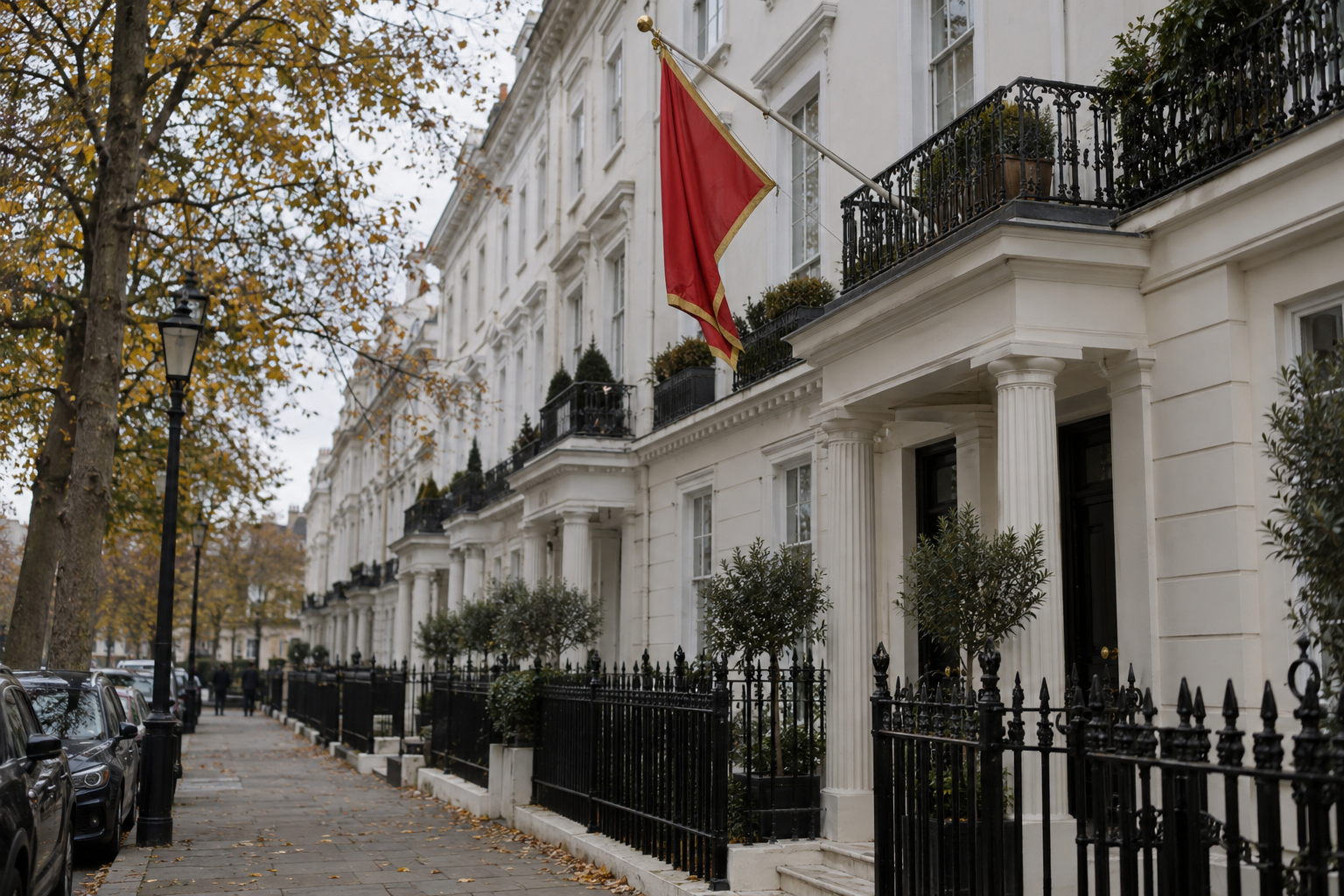
The embassy occupies what was a five-bedroom family home on Cambridge Street in central London. The Guardian reported that an application covering its change of use and flagpole came after the diplomatic mission had moved in. Some residents had already objected to the installation of the flagpole and a plaque without a prior planning application.
Simpson, 35, lives with her parents next door and has lived on the street for more than three decades, according to the report. She has been diagnosed with clinical anxiety, long Covid and a functional neurological disorder. Her challenge alleges that the council did not properly take those conditions into account when considering the embassy’s arrival.
In her legal grounds, Simpson describes disrupted sleep and occasions when she feels compelled to leave her bedroom because of anxiety about the adjoining premises. She acknowledges that the possibility of an intruder entering from the embassy is very slim, according to the account published by the Guardian. Those statements describe her reported symptoms, rather than evidence of a security incident.
Westminster City Council denies the allegations and is seeking summary judgment without a hearing, the Guardian reported. The case was before Mr Justice Mould for consideration at the time of publication. The source report did not give a ruling or a date for any future hearing, so it does not establish whether Simpson’s challenge will succeed.
The background
Cambridge Street’s Grade II-listed houses have white late-Regency frontages designed by Thomas Cubitt, according to the Guardian. Objections submitted to the council in spring 2026 included criticism of the embassy’s flag and flagpole as unsuitable for that setting. These concerns about appearance formed part of the neighbourhood dispute, alongside Simpson’s separate arguments about her health and the council’s decision-making.
Listed status adds a distinct layer of control over alterations to protected buildings. In England, works affecting a listed building’s special architectural or historic interest generally require listed building consent, which is separate from planning permission. The distinction is explained in Property Pulse UK’s coverage of Historic England’s guidance on listed-building consent; the source report does not set out every consent involved in the embassy case.
A change in how a building is used also raises different questions from a change to its physical fabric. Moving from a family home to diplomatic premises can therefore involve more than the appearance of a flagpole or plaque. For wider context, Property Pulse UK’s report on Historic England’s approach to building conversions examines the issues surrounding new uses for existing properties.
The Guardian placed the Pimlico dispute within a wider pattern of smaller diplomatic missions moving into residential buildings in London. It reported that rent increases and landlords selling properties can prompt embassy relocations. Belgravia, South Kensington, Knightsbridge and Mayfair remain established diplomatic locations, while nearby residential streets can offer alternatives to more expensive premises.
The report also described Turkmenistan’s recent move into a former family home on Victoria Road in Kensington, where a neighbour objected during consultation. North Korea, by contrast, has operated for about two decades from a seven-bedroom 1920s house near the A406 in Ealing. These examples concern separate premises and councils; they do not determine whether Westminster handled the Montenegro application lawfully.
Read moreMackintosh House gains Category A protection alongside Glasgow gallery
What people are saying
Simpson told the Guardian she was confident in her case. Her allegations include breaches of the Human Rights Act and Equality Act, irrational decision-making and a flawed public consultation. She argues that the council approached objections with a closed mind after the Foreign Office had given permission, rather than properly considering the circumstances she raised.
Her legal account also describes concern about whether she can continue living in the family home. According to the Guardian, she had expected to retain the option of living there throughout her life and regards the surrounding community as an important connection. Her claim therefore extends beyond dislike of the embassy’s appearance to its alleged effect on her ability to remain at home.
Westminster’s defence rejects the suggestion that there has been a plausible interference with Simpson’s home or private and family life, according to the report. A council spokesperson said local authorities must make decisions in accordance with existing planning policy. The spokesperson declined to discuss the case further while the proceedings were under way.
The Guardian reported that Montenegro’s chargé d’affaires invited neighbours to an evening reception, which eased some residents’ objections. One resident nevertheless suggested that an earlier introduction would have been preferable. The article did not provide a substantive embassy response to Simpson’s legal allegations, so the reception should not be treated as a formal answer to her claim.
Reactions elsewhere were mixed rather than uniformly hostile. The Kensington resident who objected to Turkmenistan’s arrival later told the Guardian that the embassy had been quiet and had caused no problems so far. In Ealing, retired solicitor Colin Flood and a nearby workman gave favourable accounts of North Korea’s embassy as a neighbour, describing little disturbance and positive personal contact.
What happens next
The immediate legal question concerns Simpson’s challenge and Westminster’s request to dispose of it without a hearing. The Guardian’s report does not establish what procedural decision Mr Justice Mould will make. It also gives no timetable for a final determination, so there is no confirmed date when residents or the council can expect an outcome.
Judicial review generally examines whether a public authority made a decision lawfully, rather than asking a judge to decide a planning application afresh. In this case, Simpson’s stated grounds concern the treatment of her disabilities, consultation and the rationality of the decision. Whether those arguments establish a legal error remains for the court to determine.
The distinction matters for anyone following a nearby change of use. Disagreeing with a planning decision is not, by itself, the same as showing that the authority acted unlawfully. Simpson’s application asks the court to examine alleged failures in the process and legal duties, rather than simply choose between residents who welcome the embassy and those who oppose it.
For owners of neighbouring listed homes, heritage protection is another separate issue. Grade II status protects a building’s special interest; it does not automatically prevent every alteration or new use. Property Pulse UK’s explanation of what Grade II listing protects provides context, but it does not establish whether any particular work at the Montenegro embassy required additional consent.
There is also no reported order requiring Montenegro to leave Cambridge Street. Although Simpson is seeking potential damages, the Guardian did not specify an amount or report any award. Any later account of the dispute will need to distinguish between the court allowing arguments to proceed, finding a legal error and granting a particular remedy.
Why this matters
For homeowners facing a change of use next door, this dispute highlights the distinction between objecting to a proposal and challenging the legality of a council’s decision. Simpson alleges that Westminster failed to consider her individual circumstances; the council rejects that claim. The case has not produced a reported ruling establishing a wider precedent. Residents should also distinguish planning permission from listed building consent, because approval under one system does not automatically answer questions under the other.
Your questions answered
+Where is the Montenegro embassy involved in the planning dispute?
The embassy occupies a former five-bedroom family home on Cambridge Street in Pimlico, central London, according to the Guardian.
+Why is the Montenegro embassy neighbour taking the council to court?
Diana Simpson alleges Westminster City Council failed to consider her disabilities and the embassy’s effect on her mental health. She also challenges the consultation and the rationality of the decision. The council denies the allegations.
+Is Diana Simpson suing Montenegro?
The reported judicial review claim is against Westminster City Council over its handling of planning permission, not against Montenegro.
+Did Montenegro apply for planning permission before moving in?
According to the Guardian, the application covering the change of use and flagpole came after the embassy had moved in. Residents had objected to the lack of a prior application.
+What has Westminster council said about the embassy case?
The council denies Simpson’s allegations and is seeking summary judgment without a hearing. Its spokesperson said councils must make decisions in accordance with existing planning policy.
+Has the High Court ruled on the Montenegro embassy dispute?
The Guardian reported on 29 October 2026 that the case was before Mr Justice Mould for consideration. Its report did not give a ruling or a future hearing date.
+Does Grade II listing stop a house becoming an embassy?
Listing does not automatically prevent a new use. Planning permission and listed building consent address different issues. The source report does not provide a complete account of every consent involved in the Montenegro embassy case.
+What does judicial review mean in a planning dispute?
Judicial review generally examines whether a public authority made its decision lawfully. It is not a fresh planning application in which the judge simply chooses whether the proposed use is desirable.
This story draws on reporting first published by Guardian Property.

Priya Raman, Environment & Homes Reporter
Priya reports on how weather and climate affect British homes, from flooding to drought-driven subsidence. She trained at Cardiff University's school of journalism and has covered environment stories across Wales and the South West.