New homes in flood-risk areas face future insurance uncertainty, Aviva warns
New homes in flood-risk areas could become difficult to insure, Aviva’s chief executive has warned, putting the location and resilience of developments under scrutiny.
What happened
New homes in flood-risk areas in England could become uninsurable in future, Aviva chief executive Amanda Blanc has warned. In a BBC interview reported on 29 September 2026, she urged planners and housebuilders to reconsider where homes are being developed. Her warning concerned the long-term availability of cover, rather than an announced withdrawal of insurance from particular properties.
Blanc said 110,000 homes had been built in flood-risk areas during the previous decade. She estimated that a further 115,000 could be built in such locations over the following ten years if the pattern continued. Those figures formed the basis of her challenge to development decisions: construction today can leave households exposed to risks that become harder to manage later.
Speaking on the BBC’s Big Boss Interview podcast, Blanc explained that insurance depends on sharing uncertain losses across customers. In her account, that model becomes difficult to sustain when damage moves from a possibility towards an expected occurrence. Her comments did not set a flood-frequency threshold at which Aviva would stop offering a particular home cover.
For buyers, the distinction is between a property being insurable when purchased and remaining insurable throughout ownership. Buildings insurance is normally a condition of a residential mortgage, so the issue extends beyond the cost of repairing flood damage. A future shortage of suitable cover could also complicate borrowing or a sale, although Blanc did not identify individual developments facing that outcome.
The warning adds a location question to the debate about housing supply: how many homes are delivered is not the only consideration. Property Pulse UK’s coverage of housebuilding output and delivery pressures examines the construction side of that debate. Blanc’s intervention focused instead on whether the homes being delivered will remain practical to insure.
The background
The Environment Agency estimates that about 6.3 million homes and businesses in England face some risk of flooding. It projects that the total could reach about eight million by the middle of the century as climate change increases the threat. The agency describes that future exposure as roughly one in four properties; its figures cover businesses as well as homes.
Separate Aviva research identified 101,657 new homes with some current flood risk, equivalent to 26.0% of the properties assessed. It also suggested that one in seven would face medium to high flood risk by 2050. Those research findings should not be treated as interchangeable with Blanc’s figure of 110,000 homes built in flood-risk areas over ten years.
The reported findings do not provide enough detail about the research sample, assessment period or risk categories to turn those totals into a verdict on any particular address. Nor does having some flood risk mean that a home is currently uninsurable. The figures describe exposure across groups of properties, while a buyer needs evidence about the specific home and the cover available for it.
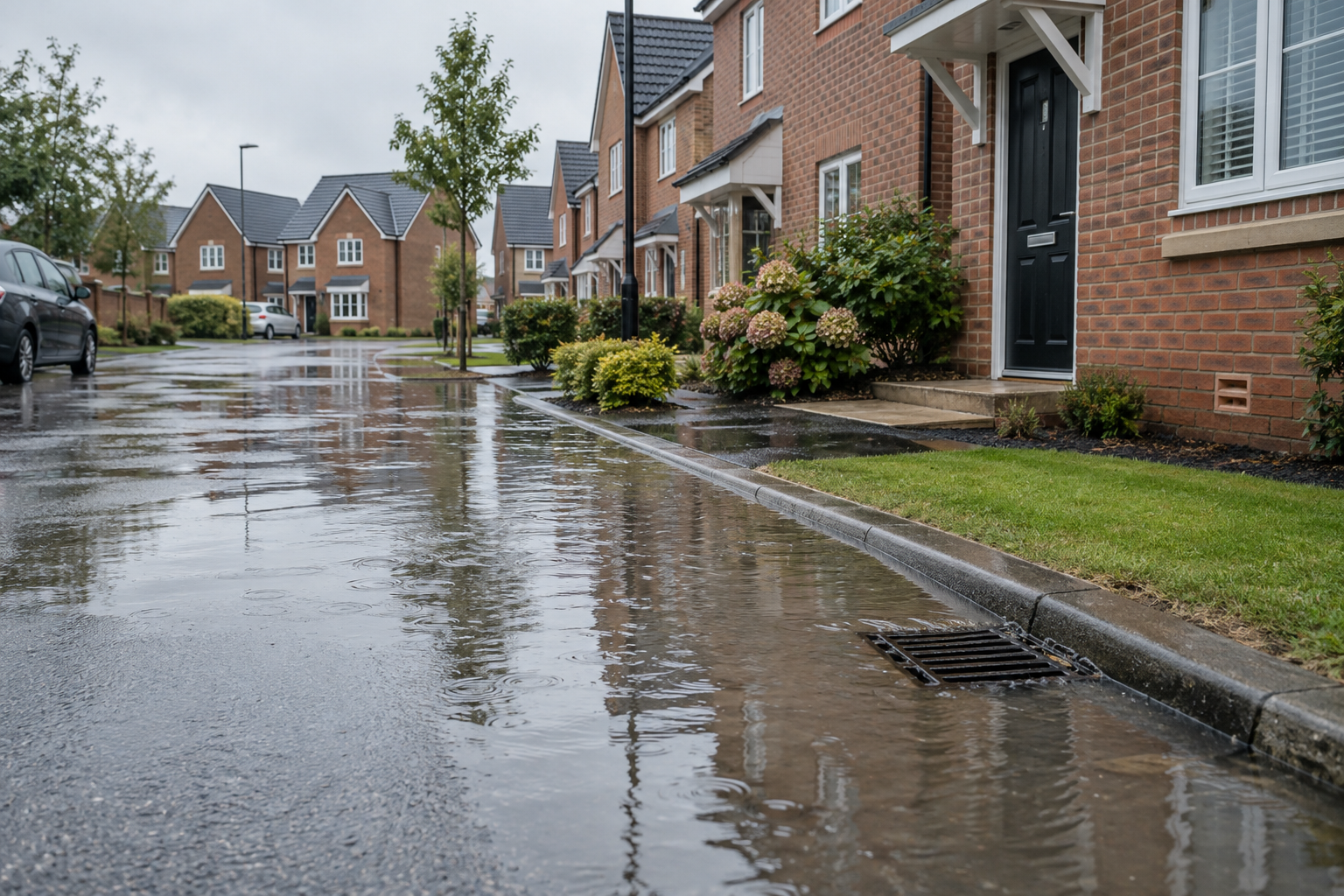
Blanc highlighted surface water flooding as a concern after a dry summer. She explained that heavy rain falling on very dry ground can produce more water flowing across the surface rather than soaking away. That mechanism matters because a buyer’s flood checks should not be limited to whether a river or the sea is visibly close to a property.
The Met Office’s assessment after the wet and stormy UK winter of 2023–24 provides wider climate context. It estimated that winters of that kind had shifted from roughly once in 80 years to once in 20 years. Those estimates concern the likelihood of a type of winter across the UK, not a prediction that an individual home will flood at a fixed interval.
Read moreHome insurance after flooding costs £239 more a year in comparison study
What people are saying
Blanc’s central message to planners and housebuilders was that known flood exposure should influence where construction takes place. She argued that continuing to add homes in those locations could create insurance problems for their eventual owners. Her comments placed responsibility on decisions made before occupation, rather than suggesting that householders alone should deal with the consequences afterwards.
The Aviva chief executive also said changes to buildings could reduce the damage flooding causes. She cited air bricks with vents that close automatically, stainless steel kitchens rather than water-vulnerable wooden fittings, and electrical sockets positioned higher up walls. These examples concern how a building responds when water reaches it, rather than removing the underlying possibility of flooding.
That distinction is important when weighing a developer’s description of a resilient home. Measures designed to limit damage do not, by themselves, establish that floodwater cannot enter or that an insurer will always provide affordable cover. Blanc presented adaptations as ways to reduce vulnerability; she did not promise that any particular combination would guarantee a property’s future insurability.
The Environment Agency’s figures and Aviva’s findings address different parts of the same problem. The agency describes exposure across England’s existing homes and businesses, while the insurer’s research focuses on new homes. Neither set of national figures replaces an address-level assessment, and the reported interview supplied no postcode list, development names or property-specific insurance decisions.
For households, this is also distinct from the routine question of whether a renewal premium has risen. A higher price means cover is being offered at a different cost; unavailability means suitable cover cannot be secured. Property Pulse UK’s guide to home insurance prices and renewal quotes covers the pricing issue, while Blanc’s warning raises the more fundamental question of continued access.
What happens next
Blanc’s comments were a warning about future development and insurance risk, not an announcement of new planning rules. The reported interview gave no timetable for an Aviva policy change or deadline for owners to adapt their homes. It therefore does not establish that buyers in a particular area will lose cover, or that existing policies are being cancelled.
For someone considering a new-build home, the practical question is what evidence supports the assessment of that particular site. Relevant enquiries include the sources of flood risk, the drainage arrangements and any measures incorporated into the building to limit damage. A general description of the development as new or resilient does not answer all of those questions.
Insurance should be checked alongside those enquiries, rather than treated as a detail to resolve after committing to a purchase. A quotation allows a buyer to examine the premium, flood excess and exclusions for the address under consideration. It shows what is being offered at that point, but cannot settle the longer-term uncertainty that Blanc described.
Buyers should also distinguish proposed ways of presenting flood information from requirements already in force. Property Pulse UK’s report on Flood Performance Certificate trials in England explains the distinction between trials and a possible sales requirement. Blanc’s interview did not announce a certificate scheme or make such a document a condition of buying or selling a home.
Existing owners considering the adaptations Blanc described would need measures suited to their building and the way water could enter it. Discussing proposed work with an insurer can help establish whether it affects the terms offered, without assuming that expenditure will automatically produce a lower premium. Her warning leaves the key uncertainty unresolved: how future flood exposure will translate into cover for individual homes.
Why this matters
For buyers in England, Blanc’s warning makes flood exposure a question about the full period of ownership, not just whether a new home can be insured on completion. Existing owners also have reason to understand their cover and the adaptations available. The national figures do not determine the prospects of an individual property, but they underline why address-specific flood information and insurance terms belong alongside price, condition and mortgage affordability when assessing a purchase.
Your questions answered
+Will new homes in flood-risk areas become uninsurable?
Aviva chief executive Amanda Blanc warned that some could become uninsurable in future. She did not announce a blanket withdrawal of cover, identify affected developments or give a timetable.
+How many new homes have been built in flood-risk areas?
Blanc said 110,000 homes had been built in flood-risk areas over the previous decade. She estimated that another 115,000 could follow over the next ten years if the pattern continued.
+How many properties in England are at risk of flooding?
The Environment Agency estimates that about 6.3 million homes and businesses in England face some flood risk. It projects that this could rise to about eight million by mid-century.
+Can flood risk affect my mortgage or house sale?
Yes. Buildings insurance is normally a mortgage condition. If suitable cover becomes unavailable or prohibitively expensive, that can complicate borrowing and make selling a property more difficult.
+Can a house flood if it is not near a river?
Yes. Blanc highlighted surface water flooding, including when heavy rain falls on very dry ground. Distance from a river or the sea does not, by itself, establish that a home has no flood risk.
+What home improvements can reduce flood damage?
Blanc suggested self-closing air vents, stainless steel kitchens and electrical sockets higher up walls. She described these as ways to reduce vulnerability, not as measures that guarantee future insurance cover.
+What should I check before buying a new-build home with flood risk?
Ask about the site’s flood assessment, drainage and damage-reduction measures. Obtain an insurance quotation and examine the flood excess and exclusions. Current cover does not guarantee that the same terms will remain available indefinitely.
This story draws on reporting first published by Guardian Property.

James Okafor, Consumer Affairs Reporter
James writes about the practical side of moving home — conveyancing, surveys and mortgages. Before joining Property Pulse UK he spent six years on a consumer rights desk investigating complaints against estate agents and lenders.