Housebuilding target: falling output raises questions over delivery
The housebuilding target faces renewed scrutiny after reported ONS figures showed three monthly falls in private residential new-build output, alongside warnings about development costs.
What happened
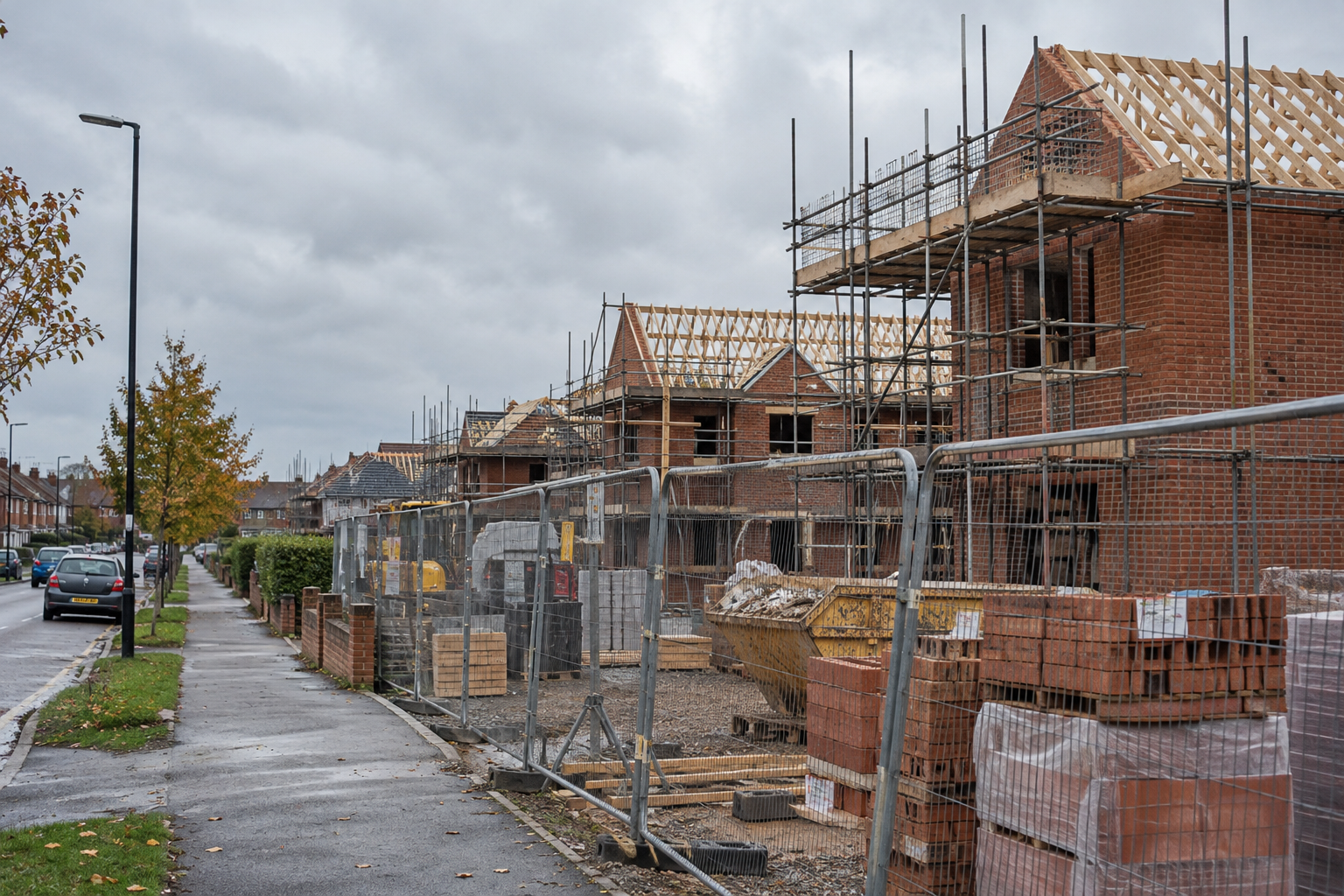
The Government’s housebuilding target faces fresh questions after ONS figures reported by The Negotiator showed three consecutive monthly falls in private residential new-build output across Britain. The report, published on 16 October 2026, comes alongside warnings from developers and development lenders about the financial pressures on new projects. The Government’s stated ambition is to deliver 1.5 million homes by 2029.
The figures reproduced in the report were 3,309 for May, 3,293 for June, 3,163 for July and 3,103 for August. Each month after May was lower than the previous one. The report does not specify the unit used in this series, so these figures should not be presented as a count of individual homes built.
That distinction matters when comparing the figures with a target expressed in homes. Construction output measures building activity, while completions record homes that have been finished; the two are not interchangeable. The reported decline therefore provides evidence of weaker activity in this particular series, rather than a direct calculation of how many homes remain to be delivered.
The source also describes a private-sector series, not a total covering every form of housing delivery. It does not provide a regional breakdown, an explanation of seasonal adjustments or a separate count of completed properties. Those limits mean the figures alone cannot establish whether a particular town will receive fewer homes, or how the full-year total will compare with the Government’s ambition.
The background
The latest figures follow a warning from Savills in June that the 1.5 million-home ambition was on course to be missed by more than 660,000 homes. That was a forecast of the eventual shortfall, not a tally of homes already missing from delivery. The source does not reproduce Savills’ assumptions, so it is not possible to assess from this report how the newer output figures compare with its projections.
Earlier in October, Taylor Wimpey said it had stopped building new homes in London, according to The Negotiator. The housebuilder attributed its position to the expense of getting developments under way. Its statement concerned its own activity in the capital; it should not be taken to mean that every developer has stopped building across London.
Real Estate:Scotland also warned that the financial viability of new housing in Scotland was under severe pressure, the report said. This was a separate industry warning, rather than a Scottish breakdown of the ONS figures. Taken individually, the London and Scotland statements identify concerns in different markets, but the source supplies no comparable regional figures showing the scale of each problem.
Development viability is the assessment of whether a scheme’s expected income can cover its costs and provide an acceptable return. Planning permission is a separate hurdle: securing consent does not itself pay for land, construction or borrowing. This distinction helps explain why debates about councillors’ role in planning decisions and planning staffing and appeals concern only part of the process of getting homes built.
Read moreYour First Home scheme: Bellway forecasts more building but warns buyers may wait
What people are saying
Terry Woodley, managing director of development finance at Shawbrook Bank, said the output decline reflected uneven conditions for the industry. He identified construction costs, borrowing costs and buyer demand as factors developers must weigh before committing to another project. His assessment puts the emphasis on whether the finances of a proposed development work, rather than on demand for housing alone.
Woodley also said predictable planning times helped developers manage costs and decide when building could begin. That is a point about the reliability of a timetable, as well as the speed of an individual decision. In his account, developers need enough certainty to coordinate spending and a start date, rather than simply an expectation that permission might eventually be granted.
Woodley suggested that Your First Home could support buyer demand and said the forthcoming Budget offered an opportunity to help smaller developers and accelerate delivery. These were suggestions about possible support, not confirmation of Budget measures. The source gives no details of Your First Home’s eligibility, funding or timetable, so it provides no basis for telling a buyer that they qualify for assistance.
Neil Leitch, managing director of development finance at Hampshire Trust Bank, said encouraging purchases of newly built homes needed to be matched by developers’ capacity to supply them. He called for a dependable flow of financially workable projects and confidence to commit money to construction. His position is that buyer support cannot substitute for viable developments, a distinction also relevant to the wider debate about housing costs and demand.
What happens next
The forthcoming Budget is the next policy opportunity identified by Woodley, but the source gives neither its date nor any confirmed housing measures. His comments should therefore be read as a request for action rather than an announcement that support is coming. The report also contains no government response setting out whether the new figures will prompt a change in policy or delivery forecasts.
To assess progress towards the target, readers will need figures that count homes delivered over the relevant period, alongside evidence about construction activity. Planning permissions, building starts and completions describe different stages, and a change in one does not immediately translate into the same change in another. The report does not provide all of those measures or give a date for their next publication.
For someone considering a newly built property, the national figures cannot establish when an individual home will be ready. That requires information about the specific development, its construction stage and the terms of the purchase. Taylor Wimpey’s London statement also does not identify affected sites or explain what its decision means for any particular buyer, so it cannot answer questions about an existing reservation.
The figures provide no forecast of sale prices or mortgage rates either. Buyer demand is one of the factors Woodley identified, but a household’s ability to proceed also depends on its deposit, income and borrowing terms, as explored in coverage of family-home affordability and mortgage costs. A weaker national construction reading is not, by itself, evidence that a particular new home will become cheaper or that finance will be easier to obtain.
Why this matters
For buyers, the reported decline raises questions about future housing delivery, but it does not establish what will happen to prices or a particular development. The lenders’ comments highlight the distinction between encouraging purchases and making projects affordable to build. Anyone considering a newly built home needs site-specific information about progress and purchase terms. The national figures also need careful interpretation: the source does not provide a completed-home count that can be directly measured against the Government’s target.
Your questions answered
+What is the Government’s housebuilding target?
The Government’s stated ambition is to deliver 1.5 million homes by 2029, according to the report. Savills warned in June that delivery could fall short by more than 660,000 homes.
+Has housebuilding output fallen?
ONS figures reproduced by The Negotiator show three consecutive monthly falls in Britain’s private residential new-build series, from 3,309 in May to 3,103 in August. The source does not specify the units.
+Were only 3,103 homes built in August?
The report does not establish that. It gives 3,103 as the August figure in a construction series without stating its unit. It should not be treated as a count of completed homes.
+Why has Taylor Wimpey stopped building in London?
According to The Negotiator, Taylor Wimpey said in October that the cost of starting developments had made new schemes financially unworkable. The report does not identify individual sites or explain the implications for existing buyers.
+Why are developers struggling to build new homes?
Shawbrook Bank’s Terry Woodley identified construction costs, borrowing costs, buyer demand and predictable planning times as important factors. Hampshire Trust Bank’s Neil Leitch said developers needed viable projects and confidence to commit funding.
+Will the Budget include help for smaller housebuilders?
The source confirms no measures. Woodley said the forthcoming Budget offered an opportunity to support smaller developers and speed up delivery, but that was a policy suggestion rather than an announcement.
+Does falling construction output mean new homes will get cheaper?
The report provides no house-price forecast. National construction figures cannot establish the future price of a particular property, and buyer affordability also depends on deposits, income and mortgage terms.
This story draws on reporting first published by The Negotiator.

James Okafor, Consumer Affairs Reporter
James writes about the practical side of moving home — conveyancing, surveys and mortgages. Before joining Property Pulse UK he spent six years on a consumer rights desk investigating complaints against estate agents and lenders.