Planning reforms raise concerns over councillors’ role in local decisions
Planning reforms due on 31 October would give council officers more control over applications, prompting concerns about residents’ access to elected decision-makers in Greater Manchester.
What happened
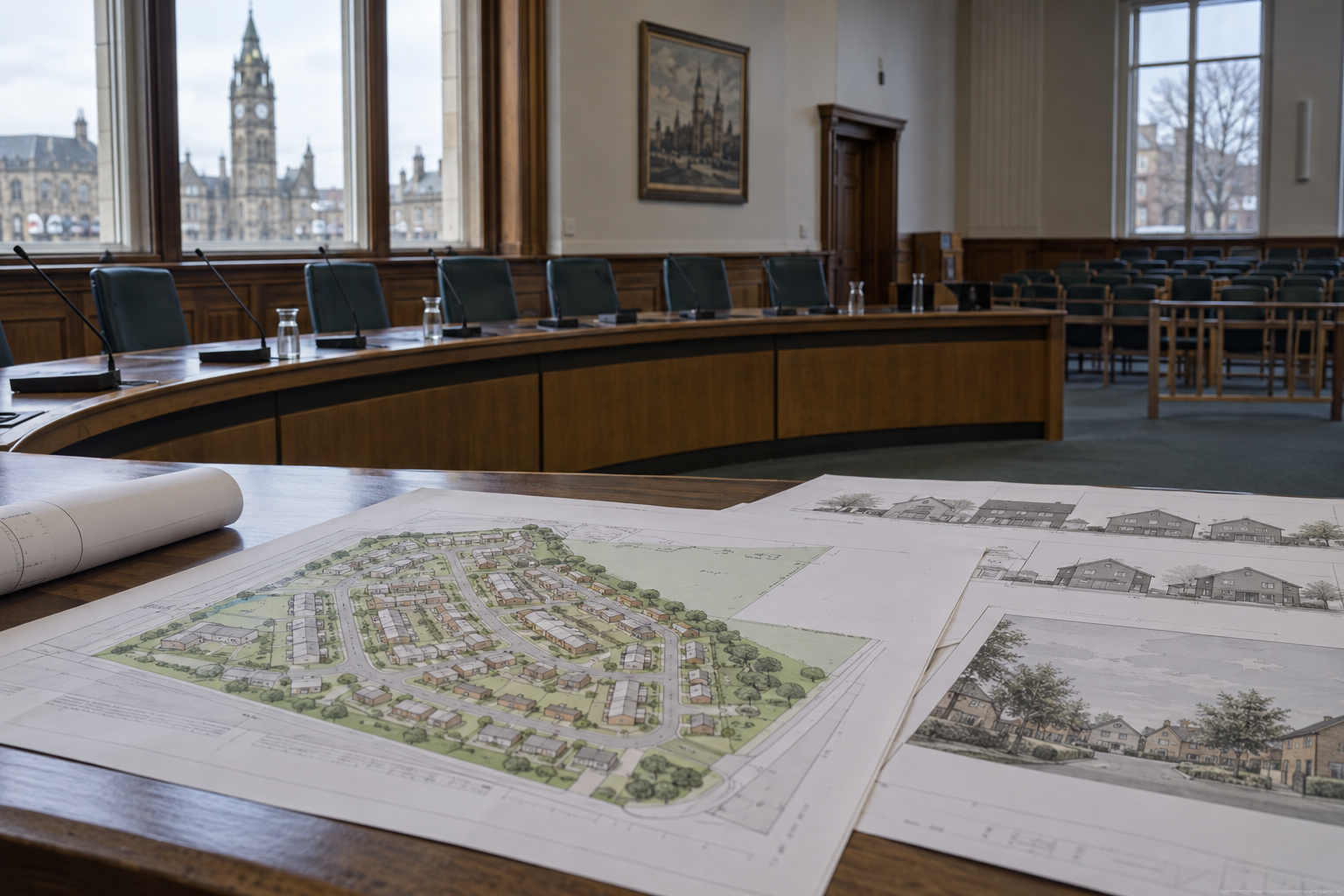
Planning reforms expected on 31 October 2026 would change who decides local applications, giving council officers more responsibility and reducing the role of elected planning committees. According to a Manchester Evening News report published on 22 September 2026, councillors in Rochdale and Tameside have challenged the changes. Their central concern is whether elected representatives will still be able to bring contentious proposals before a committee.
The reported system would divide applications into two categories, labelled Schedule 1 and Schedule 2. Smaller and more technical applications would fall within Schedule 1, while Schedule 2 would cover larger developments. The report illustrates the distinction with an attic conversion to a semi-detached house and a tower containing 1,250 homes, although those examples do not provide a complete guide to which category an individual proposal would enter.
The changes would also make planning committees smaller and require members to complete formal training, according to the report. Chief planning officers would need to sign off which applications go to a committee for a decision. Taken together, these measures concern both the membership of committees and the route an application follows before it is approved or refused.
For homeowners, the immediate issue is therefore who handles a planning application, rather than a reported change to what they can build. The Ministry of Housing, Communities and Local Government says the reforms are intended to make decisions quicker and procedures more consistent between councils. The September report gives 31 October as the intended start date, but does not explain transitional arrangements for applications already submitted.
The background
Council planning officers already decide applications through delegated powers; planning committees do not consider every proposal. Where an application reaches a committee, elected members can hear representations, discuss the planning issues and vote on the outcome. The Manchester Evening News describes a system in which developers and objectors contribute to that process, giving a contested application a public forum before the decision is made.
Existing committee arrangements differ between councils, according to the report. Those differences include speaking time for objectors, committee membership numbers and who can request that an application be brought before councillors. A resident familiar with the procedure in one borough may therefore encounter a different process elsewhere, which helps explain the ministry’s stated aim of establishing a more consistent approach.
In Rochdale, ward councillors can currently request committee consideration through a process known as call-in, the report says. It describes this as a route often used when proposals attract strong local objections. This local procedure is the focus of the dispute: it allows a councillor to seek a committee decision, but does not itself determine whether the application will succeed.
As general planning context, changing the decision-maker is different from changing the planning policies used to assess a proposal. Committee consideration does not give neighbours a veto, and an officer decision does not by itself establish that a development is acceptable. Concerns about a proposal still need to be distinguished from questions about whether the council has followed the correct decision-making process.
The government’s stated objective also places the reforms within the wider debate about increasing housing supply. That debate extends beyond planning procedures, as reflected in the housing commission’s call for action on costs and demand. Neither the ministry’s response nor the local councillors’ comments in this report provides an estimate of how many additional homes these particular committee changes would deliver.
Read moreReedham House demolition: Manchester office plan exposes heritage divide
What people are saying
Shakil Ahmed, the Labour councillor who chairs Rochdale Council’s planning committee, identified call-in powers as the main concern raised with him. According to the Manchester Evening News, he said councillors use that route when issues arise in their wards and warned that the right would be removed. His objection centres on the ability of elected representatives to secure committee scrutiny, rather than on a particular development application.
The report also describes concern among Rochdale councillors that the reforms conflict with the principle of devolution. Their argument is that transferring more decisions away from elected committees reduces local political involvement, even while wider policy seeks to empower local government. This is a criticism of how authority would be exercised within councils; the reported arrangements would still place decisions with council planning officers.
Allan Hopwood, Reform’s leader in Tameside and a member of its planning panel, argued that the changes would weaken councillors’ ability to represent residents and challenge sensitive developments. He singled out green belt development and houses in multiple occupation as areas of concern. His comments are warnings about the potential consequences of reduced committee oversight, not evidence that the reforms themselves remove green belt policy protections or approve particular housing schemes.
The Ministry of Housing, Communities and Local Government presented a different case, telling the newspaper that modernising committees would improve efficiency and give applicants greater clarity. It said the changes would help housing and infrastructure proceed more quickly for local communities. The response reported by the newspaper did not address Ahmed’s specific concern about ward councillors’ call-in rights or set out how much time applicants could expect to save.
What happens next
The next date identified in the report is 31 October 2026, when the changes are due to take effect. The supplied account does not establish whether applications awaiting a decision would follow existing procedures or move into the new system. Anyone with a live application should therefore check the council’s published arrangements rather than assume that submitting before that date guarantees a particular decision-making route.
For householders preparing a proposal, useful questions include which schedule it would fall under, who would decide it and whether committee consideration remains possible. The attic-conversion example in the report should not be read as a statement that every loft project needs planning permission. As general UK context, some domestic work can proceed under permitted development rights, subject to the applicable conditions and restrictions.
Neighbours concerned about a nearby application should distinguish a request for committee consideration from submitting planning comments. The report does not set out new arrangements for neighbour notification, written objections or public speaking. Checking the council’s application record and published deadlines remains important; asking a ward councillor to intervene should not be treated as a substitute for following the stated consultation process.
An application’s decision route is also separate from the evidence needed to assess the proposal itself. For example, questions about a site’s flood exposure are not answered simply by knowing whether officers or councillors will decide its future. The distinction between different property assessments is also relevant to the planned trials of Flood Performance Certificates, which concern flood information rather than this committee reform.
For prospective buyers, the ministry’s ambition to accelerate development is not a forecast of lower house prices or cheaper borrowing. The source provides no timetable for completed homes resulting from these changes and no estimate of their effect on affordability. Buyers still face the separate relationship between prices, deposits and mortgage costs explored in Property Pulse UK’s report on family-home affordability.
Why this matters
For homeowners and neighbours, the practical issue is access to committee scrutiny when a proposal is disputed. The ministry expects more consistent, efficient decisions, while councillors in Rochdale and Tameside fear losing an important route for representing residents. With 31 October 2026 identified as the intended start date, applicants and objectors should check their council’s procedures, particularly for live cases. A change in who decides an application should not be confused with permission to build.
Your questions answered
+When are the planning committee reforms due to start?
The Manchester Evening News reported that the changes are due on 31 October 2026. Its report does not explain how applications already awaiting a decision would be handled.
+What are Schedule 1 and Schedule 2 planning applications?
According to the report, Schedule 1 would cover smaller and more technical applications, while Schedule 2 would cover larger proposals. It gives an attic conversion and a 1,250-home tower as contrasting examples, not a complete classification guide.
+Will planning officers decide more applications?
Yes, under the arrangements described in the report. Planning officers would decide more applications without committee involvement, and chief planning officers would sign off which applications reach a committee.
+Can a Rochdale councillor call in a planning application?
The report says Rochdale ward councillors currently can request committee consideration. Committee chair Shakil Ahmed warned that this right would be removed under the reforms. Residents should check the council’s arrangements for their application.
+Do the planning reforms remove green belt protections?
The report does not establish that green belt policy protections would be removed. Tameside councillor Allan Hopwood warned about reduced local scrutiny of green belt proposals, but that is different from a confirmed change to planning policy.
+Will planning committees have fewer councillors?
The report says committees would become smaller and members would need formal training. It does not specify the new membership limits.
+Will the reforms make planning permission quicker?
The Ministry of Housing, Communities and Local Government says improving efficiency and accelerating housing and infrastructure are its aims. The reported response gives no estimate of how much time individual applicants would save.
+Does every loft conversion need planning permission?
No. As general planning context, some domestic work can proceed under permitted development rights, subject to conditions and restrictions. The report’s attic-conversion example does not mean every loft project requires a planning application.
This story draws on reporting first published by Manchester Evening News.

Sophie Carrington, Homes & Renovation Writer
Sophie writes about extensions, loft conversions and renovation projects. A former homes magazine sub-editor, she has renovated two Victorian terraces herself and focuses on costs, permissions and avoiding common pitfalls.