Reedham House demolition: Manchester office plan exposes heritage divide
Reedham House demolition plans secured approval despite heritage objections, but the developer said in May 2024 that further work was needed before demolition could begin.
What happened
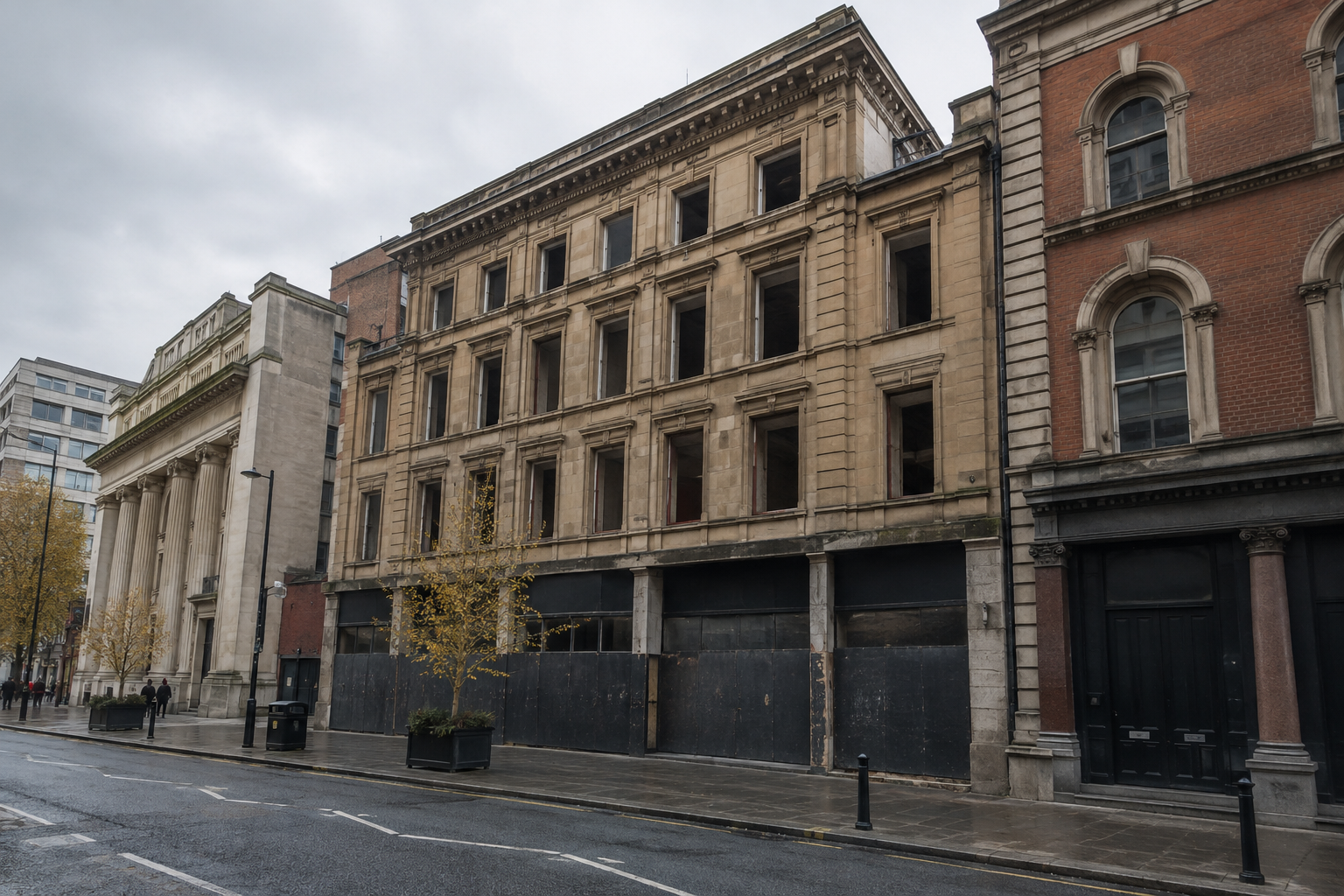
Reedham House demolition plans received council approval despite opposition from national heritage organisations, according to the Manchester Evening News report published on 17 May 2024. Property Alliance Group proposed replacing the Grade II listed building on King Street West in Manchester with a 14-storey office development. The report said Michael Gove, then the secretary of state, had declined to call in the scheme for ministerial determination.
Manchester City Council had approved the application in 2023 after councillors visited the site, the newspaper reported. The proposal concerned a historic carriage-making complex within the Parsonage Gardens conservation area, near the River Irwell. Its central trade-off was the loss of the former showroom at the street frontage alongside restoration of the carriage works behind it.
Approval did not mean demolition was about to start. A developer spokesperson told the newspaper on 17 May 2024 that further work remained before that could happen. That qualification matters because the report established the planning position at the time, rather than recording the building’s demolition or the start of construction.
The account is historical: it does not establish the condition of Reedham House or the scheme’s progress on 15 October 2026. It also concerns offices, not a residential tower or an allocation of new homes. For nearby homeowners and prospective buyers, the relevant issues are therefore the proposed change to the streetscape and the treatment of protected buildings, rather than additional housing supply.
The background
Reedham House dates from 1849 and previously displayed horse-drawn carriages made in the buildings behind it, according to the newspaper. Historic England identified the proposed demolition address as 31–33 King Street West. The organisation said the protected complex developed through the 1800s and provided evidence of the smaller industrial businesses that helped shape Manchester’s architecture.
Historic England said only five listed carriage works survived across England, making the Manchester group an uncommon example. Its objection treated the showroom and manufacturing buildings as connected parts of that history. This was a different assessment from judging Reedham House only by the age or architectural quality of the fabric that remained within it.
Under England’s listed-building system, Grade II status identifies a building as being of special architectural or historic interest. Conservation-area designation protects the character or appearance of a wider place, rather than just an individual property. Neither designation makes every change impossible, but the rules impose additional controls; permission for one redevelopment does not remove those protections from other owners’ buildings.
Planning permission and listed-building consent are distinct controls, and owners should not assume that ordinary planning approval covers work affecting a listed building’s special interest. The Reedham House report does not reproduce the full consent documents or their conditions. The wider question of who makes local planning decisions also features in coverage of proposed changes to councillors’ planning role, although those later proposals do not explain this 2023 decision.
Read moreScotland’s Places of Worship Fund opens with up to £1m for repair VAT
What people are saying
John Matthews, the project’s lead architect speaking for Property Alliance Group, told councillors that Reedham House had been substantially rebuilt in the 1920s and again after wartime bomb damage. He argued that little Victorian fabric remained inside or outside. In contrast, he said the carriage works on Garden Lane and Smithy Lane retained historic features that were in poor condition and needed restoration.
Matthews said the team had spent four years examining options, including keeping all or part of Reedham House, but had not found those alternatives viable. His case was that redevelopment would secure reuse of the more significant surviving heritage and that the new buildings were designed to reduce future energy needs. The source did not provide the underlying viability assessment or quantified energy-performance evidence.
Historic England opposed both the loss of the showroom and the scale of its replacement. It said the proposed tower would dominate the remaining carriage works and affect the wider conservation area. SAVE Britain’s Heritage likewise argued that removing one building would weaken the historic value of the group, while the tower and other planned redevelopment would substantially change the area’s character.
Guy Newton of the Victorian Society argued that the site’s importance lay partly in the survival of a complete relationship between showroom and manufacturing premises. He said later alterations did not erase that value, and placed the dispute within wider concerns about Manchester losing industrial heritage. His position challenged the developer’s emphasis on the limited original fabric remaining in Reedham House itself.
Manchester City Council said it had assessed the application against the law, its core strategy, national planning policy and the circumstances of the site. Separately, Property Alliance Group chief executive Alex Russell had told Place North West in autumn 2023 that the benefits of replacement offices and carriage-works restoration outweighed retention. Russell described the committee decision as unanimous; the council’s statement did not set out its detailed balancing exercise.
What happens next
The next step described by the developer in May 2024 was further preparatory work, not immediate demolition. The supplied report gave no confirmed start date, construction programme or completion date. It therefore cannot support a claim that the tower has since been built, that demolition remains pending, or that the project has been abandoned.
A ministerial call-in is different from a planning appeal: it allows central government to take responsibility for deciding an application rather than leaving that decision locally. Gove’s decision not to intervene left the local approval in place, according to the report, but was not a new assessment endorsing every developer argument. These routes should not be confused with the separate issues discussed in coverage of planning staffing and appeals.
For anyone assessing a nearby purchase, the council’s planning record is the appropriate place to check the approved drawings, conditions and any later applications. Those documents can distinguish an authorised proposal from subsequent changes; the 2024 news account cannot supply that detail. Buyers of listed property also need property-specific consent checks, rather than treating this decision as permission for similar work elsewhere.
The developer’s energy argument also needs to be kept separate from an established environmental outcome. The source supplied no whole-life carbon comparison between retaining Reedham House and replacing it, so lower future energy needs alone cannot settle that comparison. The distinction between operational performance and the impacts of construction is relevant to wider coverage of carbon evidence in building-material choices; it does not establish which materials this scheme would use.
Why this matters
For owners and buyers of historic property, the Reedham House dispute shows why both individual buildings and their relationship with neighbouring heritage matter in planning decisions. The council approved the scheme, while heritage organisations disputed the loss and the developer argued that redevelopment would fund restoration. Nearby buyers need current planning records, not an assumption that a 2024 approval means construction has happened. Listed-property owners must also check the consents required for their own proposed work.
Your questions answered
+Has Reedham House in Manchester been demolished?
The supplied report does not establish that. On 17 May 2024, the developer said further work was needed before demolition. It provides no confirmed update on the building’s status on 15 October 2026.
+What was planned to replace Reedham House?
Property Alliance Group proposed a 14-storey office building, alongside restoration of the carriage works behind Reedham House. The scheme described in the report was not a residential tower.
+Is Reedham House a listed building?
The report identifies Reedham House as Grade II listed and within Manchester’s Parsonage Gardens conservation area. It dates from 1849 and formerly served as a carriage showroom.
+Why did Historic England oppose the Reedham House plans?
Historic England opposed the loss of the historic showroom and the proposed tower’s impact on the remaining carriage works and conservation area. It said only five listed carriage works survived across England.
+Why did the developer want to demolish Reedham House?
The developer argued that extensive rebuilding had left little Victorian fabric. Its architect said retention options were not viable and that replacement offices would enable restoration of significant historic features in the carriage works.
+Did Michael Gove approve the Reedham House scheme?
Manchester City Council approved the application. According to the report, Gove declined to call it in for ministerial determination. Non-intervention is different from making the original local planning decision.
+Can a Grade II listed building be demolished?
Listing does not make demolition impossible, but additional legal controls apply. Planning permission and listed-building consent are distinct. The Reedham House decision does not give other listed-property owners permission to carry out similar work.
This story draws on reporting first published by Manchester Evening News.

Thomas Hale, Planning Editor
Thomas has spent more than a decade covering planning policy, building regulations and the Building Safety Act. He is known for translating dense government guidance into clear advice for homeowners.