Subsidence claims could reach £250m in four months, specialist warns
Subsidence claims could reach £250m between August and November 2026, according to Geobear, as specialists warn that drought damage is spreading beyond established hotspots.
What happened
Subsidence claims could generate £200m–£250m in insured losses between August and November 2026, according to ground engineering company Geobear. Its warning, reported on 14 September 2026, followed prolonged summer heat and drought. The estimate concerns damage associated with ground movement beneath buildings, rather than a confirmed total already paid by insurers.
Geobear chief Otso Lahtinen said a full-year total matching or exceeding £307m would not surprise him. That was the value of claims recorded for 2025, according to Association of British Insurers (ABI) figures cited in the report. His assessment was a forecast, not an ABI announcement of the eventual cost for 2026.
The latest completed-quarter figures in the report showed insurers paying £72m for domestic subsidence claims between April and June 2026, according to the ABI. That compared with £60m during the same three months of 2025. Those payments preceded the August-to-November period covered by Geobear's estimate and should not be confused with that forecast.
The average subsidence claim also reached a record £20,000 in the second quarter, according to the ABI data published in August. That was £2,000 higher than a year earlier. The figure describes an average across claims, not a standard repair price or an amount that every affected household can expect to receive.
For homeowners, the immediate distinction is between the national financial warning and the condition of an individual property. Neither Geobear's loss estimate nor the ABI's average claim value establishes whether a particular crack is subsidence. The forecast is also separate from changes in home insurance renewal prices, which describe the cost of buying cover rather than settling damage claims.
The background
Geobear linked the expected increase in damage to clay soils losing moisture during sustained dry weather. Clay can shrink as it dries and expand as it becomes wetter, allowing the ground supporting foundations to move. This helps explain why a period of hot weather can create a structural problem rather than simply a temporary change in garden conditions.
London and the South East have traditionally accounted for much of this type of subsidence claim, according to the specialists quoted in the report. Their exposure is associated with shrinkable clay formations. However, a regional description is not a diagnosis: subsidence risk projections do not determine the condition of individual homes.
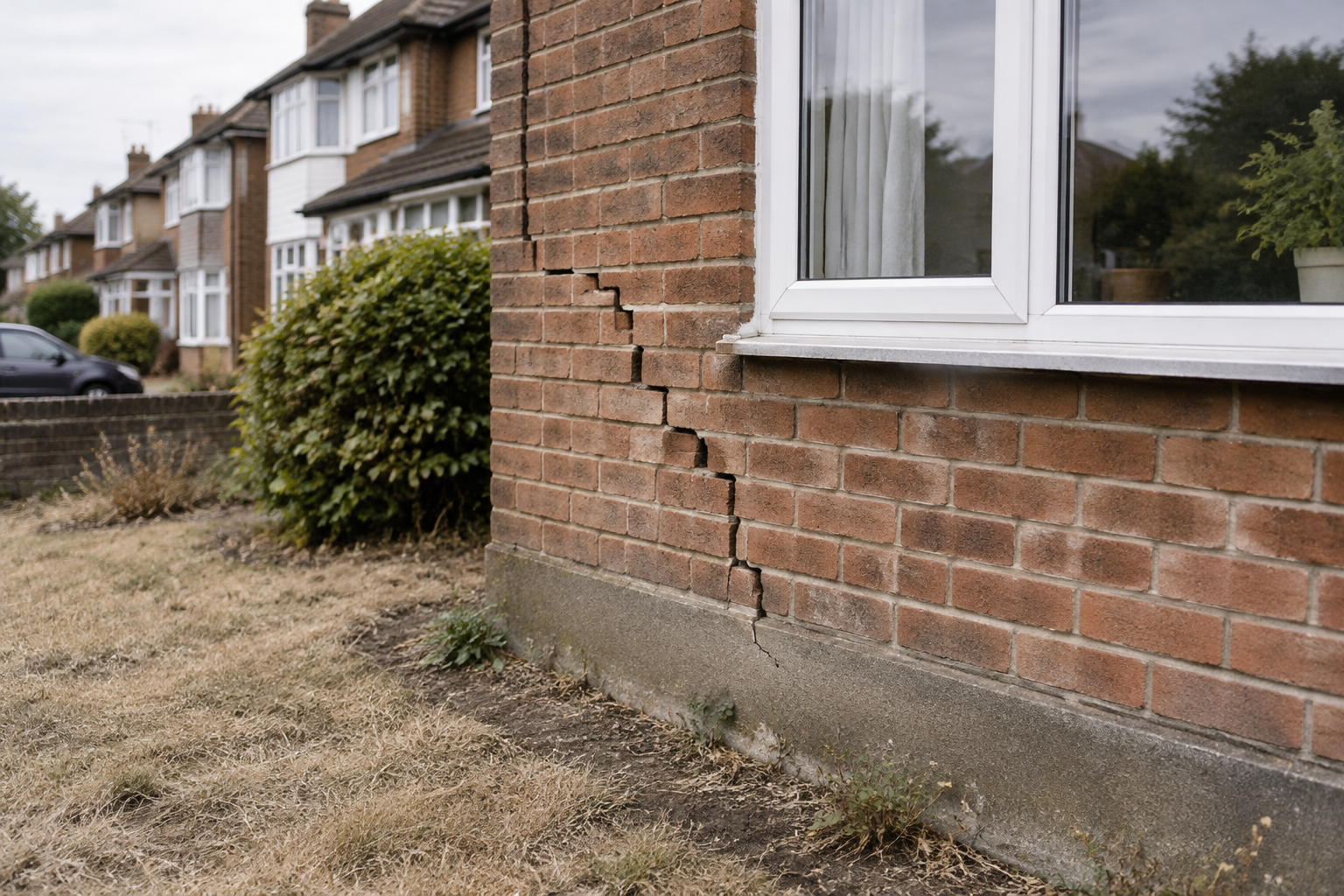
The warning signs described in the report include diagonal cracks, particularly those that are wider at the top, and cracking around windows or doors. Doors and windows that suddenly become difficult to open can also warrant attention. These are reasons to investigate a change in a building, rather than proof on their own that the foundations are moving.
Wallpaper tearing or wrinkling where there is no damp was another sign identified in the report. The absence of damp matters because it distinguishes the described warning from an obvious moisture-related explanation for damaged decoration. Taken together, the examples show why subsidence concerns are not limited to visible cracks in external brickwork.
Geobear's researchers said 14.1mm of rain had been recorded in the week to 1 September, but they did not expect soil moisture to recover until late September. That was their assessment at the time of the report, not a confirmed account of subsequent ground conditions. Their warning underlined the difference between rain falling and sustained recovery in the soil beneath a building.
Read moreSubsidence payouts reach £297m as clay-soil risks affect homebuying
What people are saying
Lahtinen described 2026 as “the most severe soil-drying season we have tracked”. The statement refers to Geobear's own monitoring, rather than establishing a national meteorological record. His company carries out ground engineering work, so its estimate should be understood as an industry assessment rather than a final tally from the insurance market.
Lahtinen said prolonged heat, limited moisture and a second consecutive affected summer were contributing to the problem. He also said most claims had come from London, while parts of the North were beginning to experience claims for the first time. That was his account of the emerging pattern, not evidence that every northern area faced the same exposure.
He pointed specifically to pockets of reactive clay in the North, while noting that these were less widespread than in the South East. His explanation was therefore about local ground conditions as well as geography. The warning does not mean that all soil types respond to drought in the same way or that location alone determines a property's risk.
Richard Rollit of claims services business Innovation Group identified East Anglia, the East Midlands and parts of Yorkshire as increasingly susceptible. He said rainfall shortages and soil moisture deficits extended into areas with substantial shrinkable clay deposits. These places, he said, do not usually produce large numbers of subsidence claims.
Rollit expected claim volumes to exceed those experienced in 2018 and 2022, suggesting 25,000–30,000 claims nationally as a planning assumption. That estimate counts claims, whereas Geobear's forecast measures insured losses in pounds. The two assessments describe different aspects of the anticipated pressure and should not be presented as interchangeable forecasts.
Adrian Hall, Chartered Engineer at Hall Davis Structural Engineers, said: “A rise in subsidence claims does not mean every new crack is subsidence. The engineering priority is to establish whether movement is ongoing and identify its cause before deciding on repairs.”
What happens next
The August-to-November forecast period remains unfinished on 15 October 2026. The September report provides no final total for that period and no full-year result. Whether losses reach Geobear's upper estimate will therefore need to be checked against subsequent insurance figures, rather than treated as an outcome already established.
Lahtinen warned that subsidence could worsen until sustained rainfall returned. His warning makes the duration of dry ground conditions important, not just the highest temperature reached during a heatwave. The report does not establish whether the soil moisture recovery Geobear expected in late September subsequently occurred.
For a household noticing new movement, documenting the damage and contacting its buildings insurer are practical starting points. Buildings insurance concerns the structure of a home; the cover available, excess and claims process depend on the policy. The £20,000 average does not settle any of those questions for an individual policyholder.
Establishing the cause of damage and deciding how to repair it are separate stages from reporting a claim. The September forecast does not give households a repair timetable or identify a treatment suitable for every affected home. Property Pulse UK's coverage of subsidence claims and repair delays examines the separate issue of getting damage resolved.
Buyers considering a home with suspected or previously reported movement need property-specific information rather than a national risk label. A survey and enquiries about any insurance claim or completed repairs can help clarify what has happened. The specialists' geographical warnings are useful context, but they cannot replace an assessment of the building being bought.
Why this matters
Geobear's forecast and the ABI's rising average claim value show why suspected ground movement deserves attention from homeowners and buyers. The warnings also extend beyond the areas most closely associated with subsidence. However, a regional risk assessment cannot establish whether a home is damaged, and a national average cannot predict its repair bill. For an individual household, the useful evidence is the building's condition, its claims and repair history, and the terms of its buildings insurance.
Your questions answered
+Have subsidence claims already reached £250m in 2026?
The £250m figure is the upper end of Geobear's forecast for insured losses between August and November 2026. The September report does not confirm that this amount has been paid or provide a final full-year total.
+How much is the average subsidence claim?
The average claim reached a record £20,000 between April and June 2026, according to the ABI. That was £2,000 higher than a year earlier. It is not a fixed repair cost or guaranteed insurance payment.
+What are the warning signs of subsidence?
Signs described in the report include diagonal cracks, cracks wider at the top, cracking near doors or windows, suddenly sticking doors and windows, and wallpaper tearing without damp. These signs require investigation; they do not prove subsidence on their own.
+Why does hot weather cause subsidence?
Geobear linked the damage to clay soils shrinking as they lose moisture during prolonged dry weather. Movement in the ground beneath foundations can affect the building above. Clay can expand again as it becomes wetter.
+Which UK areas face subsidence risk after drought?
The specialists identified London and the South East as established hotspots. Innovation Group's Richard Rollit also warned about East Anglia, the East Midlands and parts of Yorkshire. Local ground conditions matter, so regional exposure does not diagnose an individual property.
+Does rain stop subsidence straight away?
Not necessarily. Geobear said rainfall in the week to 1 September had not restored soil moisture and warned that damage could worsen until sustained rain returned. Its expected late-September recovery was a forecast, not a confirmed outcome.
+What should I do if I think my house has subsidence?
Document the changes and contact your buildings insurer. Check the policy's cover, excess and claims process. The cause of damage needs to be established before deciding on repairs; national forecasts cannot diagnose your home.
This story draws on reporting first published by Yahoo Finance.

Robert Ashdown, Period Property Specialist
Robert writes about caring for older, listed and period homes, including damp, structural movement and conservation rules. He has reported on heritage and housing for over fifteen years.