Wildfire water supplies: MPs seek safeguards after Stourbridge homes destroyed
Wildfire water supplies need stronger safeguards, MPs say, after low pressure delayed firefighters tackling a Stourbridge blaze that destroyed several homes during the summer.
What happened
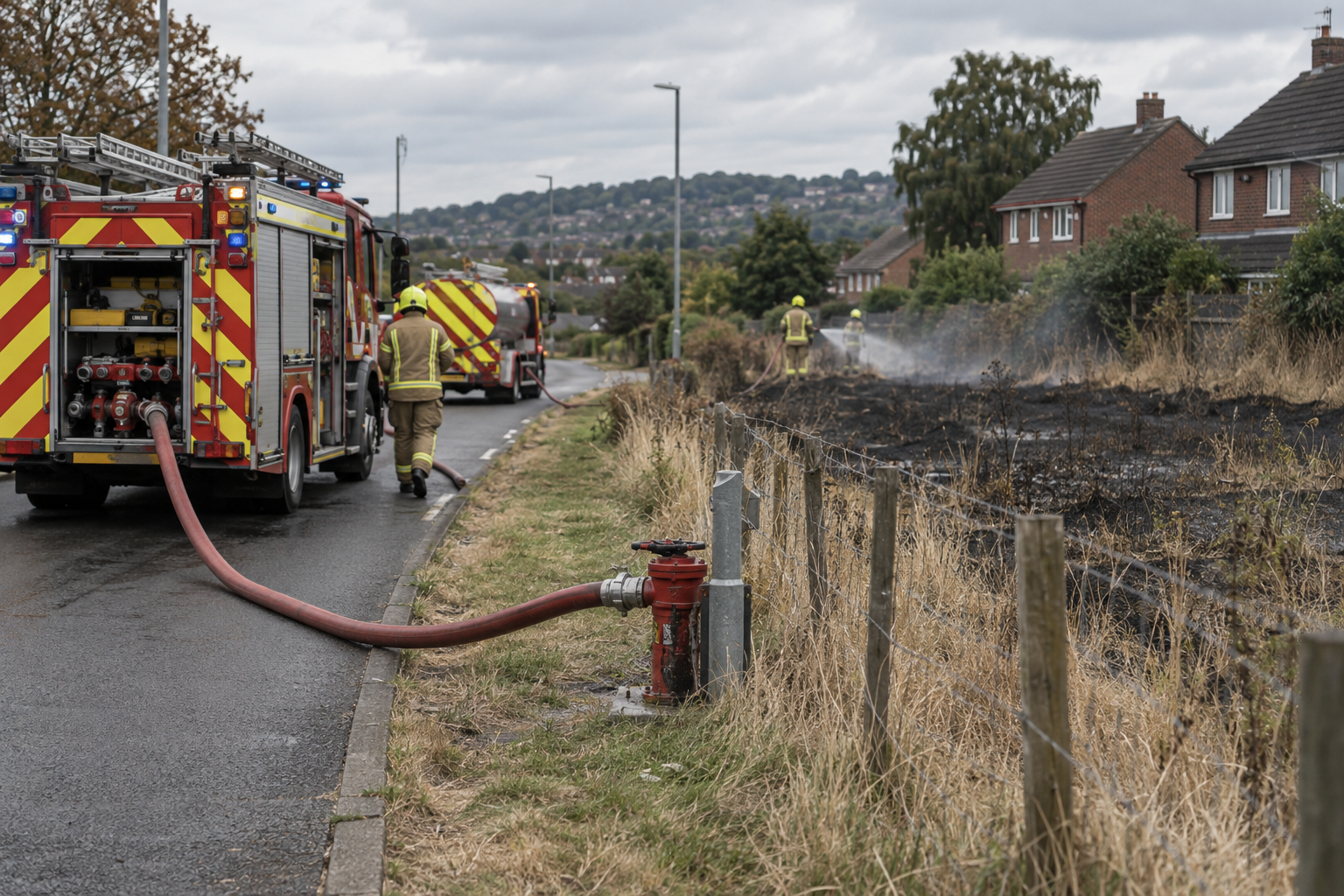
Wildfire water supplies have become a household safety concern after MPs heard that firefighters faced lengthy delays obtaining water during a blaze that destroyed several homes in Stourbridge. According to the Guardian’s report on 21 October 2026, reduced pressure meant a water carrier took almost 40 minutes to refill during the West Midlands fire.
Phil Garrigan, chair of the National Fire Chiefs Council (NFCC), told the Environment, Food and Rural Affairs (EFRA) committee that restricted supplies had allowed fires to develop more quickly. He said his concern about the availability of firefighting water had increased over his 37 years in the fire service.
The Stourbridge incident was not the only example presented in the report. The fire service tackling a separate wildfire in the New Forest in August 2026 said sustaining its water supply had posed a significant operational difficulty. Together, the accounts show that the issue extended beyond a single location.
An NFCC survey conducted during the summer found that 81% of responding UK fire and rescue services had altered emergency response plans in places where water access caused concern. The figure measures changes reported by services, not the proportion of homes facing inadequate firefighting supplies. The source report did not give the number of survey respondents.
The EFRA committee has called on the government to establish clearer responsibilities for water companies during major fires. Its proposals address the availability of water, the pressure at which it can be supplied and how utilities work with emergency crews. These are recommendations for stronger arrangements, rather than newly announced rules already in force.
The background
Fire services draw water from the mains network and from open sources, including rivers and lakes, according to the report. Drought had left some of those open sources at extremely low levels, restricting access. That matters because a problem with one source cannot necessarily be solved by switching to another nearby supply.
The report also described pressure on fire services to restrict their use of mains water so that customers did not face shortages. This puts emergency demand alongside the need to maintain everyday supplies. The wider household pressures are covered in Property Pulse UK’s reporting on England’s drought and low reservoir levels.
The NFCC said climate change, population growth, housing development and infrastructure such as datacentres were adding demand to a water network already under strain. Its concern therefore goes beyond the amount of rain falling in any particular week. For housing, the issue includes whether the network serving a growing area can also support a major emergency.
The Environment Agency estimates that England’s public water supply could face a shortfall of 5bn litres a day by 2055 without urgent action. That is a long-term projection for public supply, not a measurement of water missing from firefighting operations today. Separate proposals for drought restrictions on business water use illustrate the wider effort to protect supplies.
According to the Guardian’s account, the UK experienced its hottest recorded summer in 2026, with prolonged dry conditions and extreme heat helping wildfires spread. For property owners, fire is distinct from the ground-movement risks associated with dry weather. Property Pulse UK’s coverage of drought-related subsidence concerns examines that separate threat to buildings.
Read moreFlood risk in England: two million unaware of danger to their homes, agency warns
What people are saying
Garrigan’s evidence focused on the practical consequences of inadequate water rather than simply the volume stored across the country. His account linked limited availability with the speed at which incidents escalated. The NFCC survey supported the organisation’s position that services were already changing how they prepared to respond.
Dave Swallow, the NFCC’s deputy lead on wildfires, said services would normally seek additional resources during summers such as this one. However, those resources were not always available, leaving crews waiting longer or finding alternative ways to tackle a fire. His comments describe a constraint on the response as well as a problem with local supply.
The EFRA committee wants firefighting water to be treated explicitly as a critical public safety need. It has asked for a statutory framework and a national protocol defining water companies’ responsibilities during major incidents. The proposed approach would make expectations clearer before crews arrive at an emergency.
The committee said those expectations should cover minimum supply and pressure, communication, and operational coordination with fire and rescue services. It also wants water companies to assess, test and verify their ability to support firefighting. Committee chair Alistair Carmichael said: “Water companies must be relied upon for adequate supply.”
A government spokesperson said improving preparedness for wildfires was a priority and pointed to a planned summit involving ministers, fire and rescue leaders, land managers and other partners. The stated purpose was to consider how the response could be strengthened. The response quoted in the report did not confirm adoption of the committee’s proposed statutory framework.
What happens next
The government’s summit was described in the 21 October report as taking place that week. No outcome from that meeting is included in the supplied reporting. It therefore cannot yet be treated as evidence that new supply standards, funding or legal duties have been agreed.
A government-funded UK wildfire conference is scheduled to take place in Leeds on 10 and 11 November 2026. That provides a further dated event for the issue after the parliamentary concerns. The report does not set out a conference programme or identify specific decisions expected from it.
The central policy question is whether the government will turn the committee’s recommendations into enforceable requirements. The report gives no implementation timetable, numerical minimum pressure standard or funding commitment for network improvements. Those details would be needed to establish what any new arrangements require water companies to deliver.
The committee’s proposed testing requirement would address a different question from whether a company has an emergency plan on paper: whether it can demonstrate support for firefighting operations. Its call for communication and coordination standards also concerns how organisations work together during an incident. Neither element alone amounts to a promise that every fire will have an unrestricted supply.
For homeowners and buyers, the evidence does not provide an address-level assessment of wildfire risk or local water capacity. The reported destruction in Stourbridge shows why emergency supply deserves attention, but it does not establish that every drought-affected neighbourhood faces the same conditions. Local fire and rescue guidance remains a more appropriate starting point for household precautions than applying the national survey percentage to an individual home.
Why this matters
For homeowners, the Stourbridge evidence shows why water infrastructure matters during an emergency, not just for daily household use. The NFCC’s findings indicate that services are already adapting plans where supplies cause concern. The committee’s proposals would make water companies’ responsibilities clearer and require their capabilities to be tested. However, the reporting provides neither a timetable for those changes nor an assessment of individual properties, so it should not be read as a local risk rating.
Your questions answered
+Why are firefighters worried about wildfire water supplies?
The NFCC says water availability is affecting emergency planning. Drought can restrict access to rivers and lakes, while low mains pressure can delay refilling equipment. Its summer survey found 81% of responding services had changed plans over water-access concerns.
+What happened to the water supply during the Stourbridge wildfire?
MPs heard that reduced pressure meant refilling a water carrier took almost 40 minutes during the Stourbridge wildfire. Several homes were destroyed in the incident, according to the Guardian’s report.
+Where do firefighters get water for wildfires?
Fire services use mains water and open sources such as rivers and lakes. The report said drought had lowered open-water levels and restricted access, while services also faced pressure to avoid disrupting mains supplies to customers.
+Are water companies getting new firefighting duties?
The EFRA committee has recommended a statutory framework and national protocol. These would cover supply, pressure, communication and coordination. The reported government response did not confirm that the proposed framework would be adopted.
+Does the 81% survey figure mean my home has an unsafe water supply?
No. It describes the share of responding fire services that changed emergency plans where water access caused concern. It does not measure the proportion of homes at risk or assess the supply serving a particular address.
+How big could England’s water shortage become?
The Environment Agency estimates a potential public water supply shortfall of 5bn litres a day by 2055 without urgent action. This is a long-term supply projection, not a current firefighting deficit.
+When is the UK wildfire conference in Leeds?
The government-funded conference is scheduled for 10 and 11 November 2026. The source report does not specify its programme or any decisions expected from it.
This story draws on reporting first published by Guardian Drought.

Sophie Carrington, Homes & Renovation Writer
Sophie writes about extensions, loft conversions and renovation projects. A former homes magazine sub-editor, she has renovated two Victorian terraces herself and focuses on costs, permissions and avoiding common pitfalls.