Severn Stoke flood scheme reduces risk to homes before winter
The Severn Stoke flood scheme is operational ahead of winter, according to the Environment Agency, although landscaping and habitat work will continue over coming months.
What happened
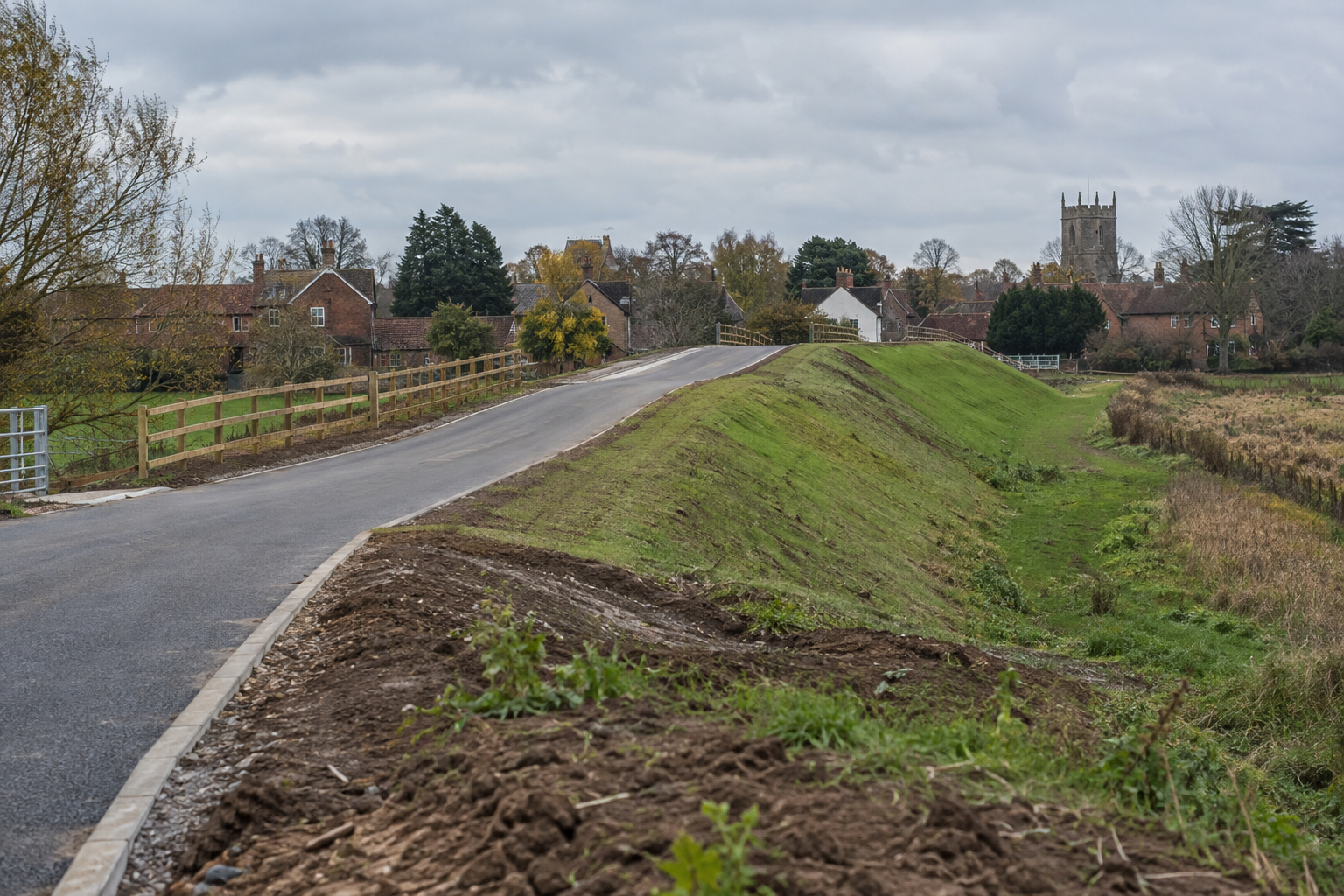
The Severn Stoke flood scheme is operational ahead of winter, reducing flood risk for homes, businesses and transport infrastructure, according to the Environment Agency. In an update published on 6 November 2026, the agency said the main scheme had finished earlier than planned. Landscaping remains to be completed.
The works include a new flood bank along the western side of the Worcestershire village, the agency said. The project also includes drainage designed to manage surface water. A section of road has been raised where it passes over the bank, bringing changes to the highway alongside the flood-protection works.
The Environment Agency delivered the scheme with Worcestershire County Council and contractor Alun Griffiths Construction Ltd. The agency said it funded approximately £5 million of delivery costs, while the council contributed a further £250,000. Its announcement did not give a separate cost breakdown for the bank, drainage or road works.
The distinction for residents is between an operational flood scheme and a site where every finishing task is complete. According to the agency, tree planting, habitat creation and fencing will take place over the coming months. Those outstanding tasks do not alter the council's statement that the scheme is already operational.
The agency also said the village war memorial would be accessible on 7 and 8 November for remembrance gatherings. That was a specific access update for the weekend following its announcement. It did not provide a wider timetable for access arrangements while the remaining landscaping work takes place.
The background
Severn Stoke has experienced repeated flooding from the River Severn, with recent winters causing severe disruption, according to the Environment Agency. It identified 18 properties, the local church, the local pub and the A38 as having been affected during significant floods. The impact has therefore extended beyond individual households to community buildings and a major road.
The figure of 18 properties describes previous flood impacts, rather than a stated total of homes now protected by the scheme. The agency's announcement did not give a property-by-property coverage list or a numerical protection standard. Buyers and residents should not treat that historical figure as confirmation that a particular address falls within the scheme's coverage.
The project addresses more than one route by which water can cause problems. The agency describes both a flood bank and works to manage surface water, rather than a river barrier alone. For householders checking their own exposure, that distinction matters: information about one type of flooding should not be treated as a complete assessment of every water-related risk.
The wider context is the government's national flood programme, which the agency says will invest at least £10.5 billion in new and existing defences up to 2036. Charlie Chandler, the agency's West Midlands area flood risk manager, said that programme would benefit nearly 900,000 properties. Those are national figures, not the budget or protection total for Severn Stoke.
Awareness remains a separate issue from the construction of defences. Property Pulse UK's report on the Environment Agency's warning about unrecognised flood risk examines why households need to check their exposure. For someone considering a purchase in Severn Stoke, the new scheme is relevant information, but it is not a substitute for checks on the individual property.
Read moreHome insurance premiums rose 31% in 2022–24, Commons research found
What people are saying
Chandler welcomed the early delivery of the scheme and said it would reduce flood risk for residents, businesses and visitors. He placed the local works within the government's wider investment in flood defences. His comments described a reduction in risk, rather than a promise that flooding could never happen again.
Councillor Josh Robinson, Worcestershire County Council's cabinet member for environment and communities, focused on the disruption and anxiety that flooding has caused locally. He said having the scheme operational before winter would help protect homes, businesses and important transport connections. He also said it would provide reassurance for the community.
The two organisations emphasised different aspects of the same project. The agency highlighted delivery and the national investment programme, while the council stressed the practical effect on village life and travel. The announcement included no comments from individual residents, local business owners or insurers.
The agency also presented flood investment as an economic measure, saying the national programme would support jobs, avoid damage and enable development. Those statements relate to the wider programme. The Severn Stoke announcement did not identify a local housing development unlocked by this scheme or put a figure on the village's expected economic benefit.
Neither organisation announced a change to household insurance prices or availability following completion. Owners should therefore avoid assuming that the works will automatically produce a cheaper renewal. The separate comparison study of home insurance costs after flooding provides context on the insurance consequences of flood history, but does not establish what any Severn Stoke household will pay.
What happens next
The next stated phase is the remaining landscaping, habitat creation, tree planting and fencing. The Environment Agency said these tasks would happen over the coming months, without naming a final completion date. Its update also did not set out a detailed programme of future maintenance for the completed defences.
For the approaching winter, the agency is encouraging people to receive flood warnings and has launched a central collection of flooding guidance. Residents should keep warning arrangements and household preparations separate from assumptions about the new bank. An operational defence is a reason to update an emergency plan, not to discard it.
Anyone buying a home locally should ask for information about its flood history and its relationship to the new works. Useful questions include whether the address benefits from the scheme and what risks remain outside its scope. The agency's village-level announcement cannot answer those questions for every property or replace enquiries made during a purchase.
Homeowners approaching an insurance renewal should check the cover offered and answer questions about previous flooding accurately. If an online application does not produce a quote, that should not be taken as a complete assessment of the market. Property Pulse UK's guide to online home insurance refusals and specialist cover explains that separate issue.
The announcement does not establish how the scheme will affect local sale prices, mortgage decisions or insurance terms. Those outcomes should not be inferred from the construction milestone. For a household making a financial commitment, the practical next step is to obtain address-specific information from the relevant insurer, lender or professional adviser.
Why this matters
For Severn Stoke households, the scheme reduces flood risk in a village where the Environment Agency says previous flooding affected properties, community buildings and the A38. But the announcement is not an address-level guarantee of protection or cheaper insurance. Owners and buyers should use it alongside checks on flood history, remaining risks and policy terms. With finishing work still ahead, residents should also distinguish operational flood protection from completion of every task on site.
Your questions answered
+Is the Severn Stoke flood scheme finished?
The Environment Agency said on 6 November 2026 that the main scheme had finished ahead of schedule. It is operational, but landscaping, tree planting, habitat creation and fencing will continue over coming months.
+What does the Severn Stoke flood scheme include?
The Environment Agency describes a new flood bank west of the village, drainage to manage surface water and a raised road section where it crosses the bank.
+How much funding did the Severn Stoke flood scheme receive?
The Environment Agency said it funded approximately £5 million of delivery costs. Worcestershire County Council contributed a further £250,000.
+How many properties have flooded in Severn Stoke?
The Environment Agency said significant past floods affected 18 properties, alongside the local church, pub and A38. It did not give a separate total of properties protected by the new scheme.
+Does the new scheme mean Severn Stoke cannot flood?
No such guarantee appears in the announcement. The Environment Agency describes reduced flood risk and continues to encourage people to receive flood warnings.
+Will the Severn Stoke flood scheme lower my home insurance?
The announcement gives no information about changes to premiums or insurance availability. Homeowners should check their own quotes and policy terms rather than assume the scheme will reduce their renewal price.
+Who built the Severn Stoke flood scheme?
The Environment Agency and Worcestershire County Council delivered the scheme in partnership, working with contractor Alun Griffiths Construction Ltd.
This story draws on reporting first published by Environment Agency.

Priya Raman, Environment & Homes Reporter
Priya reports on how weather and climate affect British homes, from flooding to drought-driven subsidence. She trained at Cardiff University's school of journalism and has covered environment stories across Wales and the South West.