Subsidence claims: Mainmark calls for repairs to address ground movement
Subsidence claims should address problems beneath homes, not just visible damage, ground engineering firm Mainmark argued in an August 2025 call for industry reform.
What happened
Subsidence claims need a stronger focus on the ground beneath damaged homes, according to Mainmark Ground Engineering UK. In a report published by the Milton Keynes Citizen on 13 August 2025, the company called for insurers, ground specialists and local government to reconsider how claims are handled as hotter weather increases concerns about soil movement.
Freya Chapman, Mainmark UK’s residential lead, argued that repairing a building without resolving the movement below it can leave owners exposed to further damage. Her criticism concerned the balance between work to the building itself and work addressing its underlying support. She said roofs and floors still needed repairs to maintain safety.
The report cited Association of British Insurers figures putting subsidence-related insurance claims at £153 million for the first half of 2025. That figure provides financial context for Mainmark’s appeal, but the report did not give a claim count or an average cost per household. It also did not quantify how many claims involved the repair practices Chapman criticised.
Mainmark linked its appeal to soil-moisture information from the Meteorological Office Rainfall and Evaporation Calculation System, known as MORECS. Chapman interpreted that information as pointing towards a surge in subsidence during 2025, particularly if hot, dry conditions continued. This was an August 2025 warning, not a confirmed assessment of the full year’s outcome.
The background
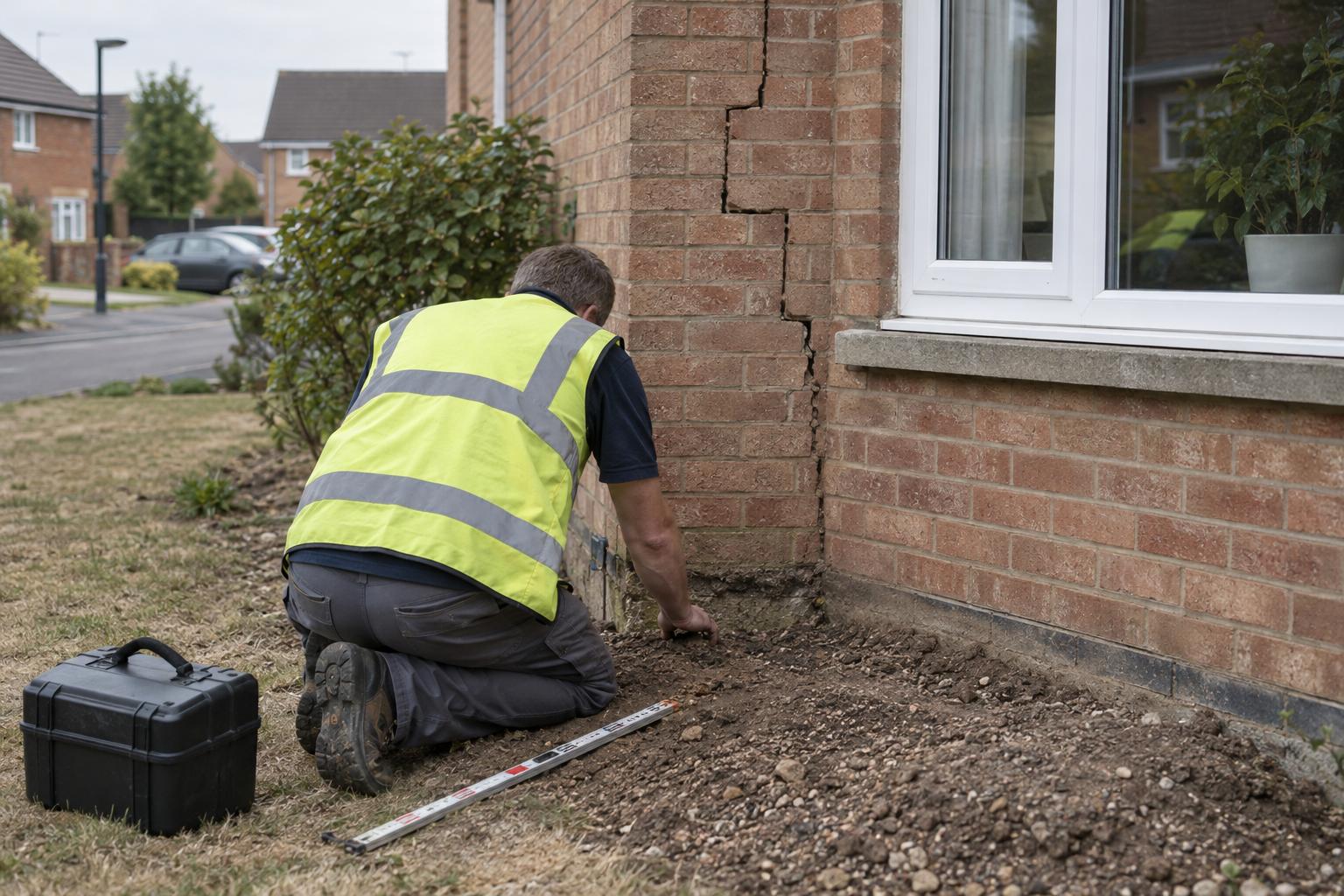
Chapman described subsidence as movement in the supporting ground, rather than simply a defect visible inside a home. Cracks and uneven floors can be consequences of that movement, but repairing those features does not itself establish that the cause has been removed. Her argument was that claims decisions should distinguish between repairing damage and resolving what produced it.
One mechanism she highlighted was clay shrinking as it loses moisture in hot weather. When the soil changes volume, it can affect the support available beneath a property’s foundations. The relationship between ground conditions and financial exposure is also explored in Property Pulse UK’s coverage of subsidence payouts and clay-soil risks for buyers.
Chapman acknowledged that subsidence has several possible causes, so her explanation should not be read as a diagnosis for every damaged home. A crack alone does not establish which process is responsible or which repair is appropriate. For an owner, the important distinction is between noticing a warning sign and obtaining an assessment of the property’s condition.
Mainmark identified widening wall cracks, sinking floors and water collecting around a property as signs worth recognising. The company said public education formed part of its work, including its role as the official subsidence partner at Grand Designs Live in 2024. Its warning concerned changes that may warrant investigation, rather than a checklist proving that subsidence has occurred.
The report also referred to the sinkhole that appeared in Godstone, Surrey, in February 2025, while discussing serious ground-related hazards. It did not supply an investigation establishing the cause of that particular incident. Homeowners should therefore not treat the example as evidence that ordinary wall cracks will develop into a sinkhole, or that all ground failures share the same cause.
Read moreHome insurance premiums rose 31% in 2022–24, Commons research found
What people are saying
Chapman’s central position was that leaving underground problems unresolved could make repeat claims more likely and increase homeowners’ costs. That is Mainmark’s assessment of the risk, rather than a finding supported in the report by a comparison of completed insurance repairs. The source supplied no figures showing the frequency or cost of repeat damage after different treatments.
She proposed collaboration through bodies such as the Subsidence Forum Committee, bringing together developers, architects, arborists, geologists, insurers and subsidence specialists. The range of professions reflects the different questions a ground-movement investigation can raise, from soil behaviour to nearby vegetation and building design. Chapman presented cooperation as an achievable route to improving decisions, not as an agreement already secured.
Chapman also pointed to research into soil-testing methods, arguing that better information could help housing associations and developers before major construction projects. She wanted this work supported by a comprehensive Climate Resilience Review. The report did not describe an adopted review programme, identify a public body responsible for delivering it or set out funding.
Mainmark is a commercial ground engineering business, so its proposals come from a company working in the field it wants to change. Its UK operation was established in 2015 and is based in Milton Keynes. The report included no response from an insurer, the ABI or a local authority to Chapman’s criticism; wider financial pressures are covered separately in reporting on subsidence claims linked to summer heat.
What happens next
The August 2025 report announced a call for reform, not a change to insurance rules or an agreed industry repair standard. It gave no implementation date, consultation timetable or commitment from an insurer to alter its claims process. Nothing in the supplied account establishes whether Mainmark’s proposals were subsequently adopted.
Chapman cited an estimate that 6.54 million homes would face medium to high subsidence risk by 2030. However, the report did not identify the underlying study, geographical coverage or definitions of those risk categories. The number should be understood as an estimate cited in support of the campaign, not a forecast that 6.54 million homes will suffer damage or make claims.
For a homeowner discussing a repair, the campaign raises a practical question: what evidence explains the movement, and how does the proposed work address it? Asking the insurer or appointed specialist to distinguish the cause from the resulting damage can help clarify the plan. Mainmark’s general criticism does not establish that any particular household needs ground treatment or that its existing repair proposal is inadequate.
Buyers considering a property with a subsidence history should separate the repair record from the availability and terms of insurance. A report about national risk cannot establish either for an individual home. Property Pulse UK’s coverage of online home insurance quote refusals and specialist cover examines the separate difficulty owners can face when seeking cover.
Owners should also distinguish questions about the quality of repairs from questions about the price of a policy. Mainmark warned that subsidence could affect premiums, but supplied no household premium forecast or estimate of savings from its proposals. For the broader renewal context, see the reporting on home insurance premiums and differences between renewal offers.
Why this matters
For homeowners, Mainmark’s campaign highlights the difference between repairing visible damage and understanding why it occurred. That distinction matters when discussing a claim, reviewing repair records or considering a purchase. The company’s warning does not mean every crack signals subsidence, or that every affected home needs the same work. It supports asking clear questions about the diagnosis and proposed repairs, while keeping national risk estimates separate from evidence about an individual property.
Your questions answered
+What change does Mainmark want to subsidence claims?
Mainmark wants claims handling to address the causes of ground movement as well as damage to the building. Its residential lead, Freya Chapman, argued that leaving underground problems unresolved could lead to further damage and claims.
+How does hot weather cause subsidence?
Chapman explained that clay can shrink as it loses moisture during hot weather. That change can affect the ground supporting a home. She also acknowledged that subsidence can have other causes.
+What are the warning signs of subsidence?
Mainmark highlighted wall cracks that grow wider, sinking floors and water collecting around a property. These signs do not prove subsidence or identify its cause; an assessment is needed to understand the property’s condition.
+How much were subsidence claims in early 2025?
The report cited ABI figures showing £153 million in subsidence-related insurance claims during the first half of 2025. It did not provide a claim count or an average cost per household.
+Will 6.54 million homes suffer subsidence by 2030?
That is not what the cited estimate establishes. Chapman referred to 6.54 million homes potentially facing medium to high risk by 2030. The report did not identify the underlying study or predict that every home would suffer damage.
+Have subsidence insurance rules changed?
The August 2025 report described Mainmark’s campaign, not an adopted rule change. It gave no implementation timetable or insurer commitment, and the supplied account does not establish whether the proposals were later adopted.
+What should I ask about a subsidence repair?
Ask what evidence explains the movement and how the proposed work addresses it. Distinguishing repairs to visible damage from action on its cause helps clarify the plan, without assuming every property needs the same treatment.
This story draws on reporting first published by Milton Keynes Citizen.

David McAllister, Insurance Correspondent
David covers home insurance, premiums and claims. Based in Glasgow, he previously reported on financial services and has written extensively on subsidence and flood cover.