Subsidence claims rise sharply as insurers count the cost of summer heat
Subsidence claims rose sharply after the record-hot summer of 2026, with insurers warning that rainfall would determine how long the increase lasted.
What happened
Subsidence claims increased sharply during summer 2026, with Hastings Direct reporting almost 140% more claims in August than in the same month of 2025. The insurer said it was its busiest August for subsidence claims. The figures, reported by The Guardian on 5 September 2026, showed pressure on insurers before the usual late-summer and autumn peak had passed.
The Guardian reported that insurance companies had received more calls, online enquiries and claims during a summer marked by five heatwaves. That followed the warmest spring recorded in England and Wales. Axa linked its expectations for more weather-related property damage to the Met Office’s announcement that summer 2026 was the UK’s hottest on record.
Hastings attributed the increase in subsidence activity to two unusually dry summers. The company had 4.8 million home and motor insurance customers, according to the report, but did not give an absolute number of subsidence claims. Its near-140% increase therefore describes the change within its own business, rather than a measured increase across the whole insurance market.
The Association of British Insurers said the average UK subsidence claim reached a record £20,000 between April and June 2026. That was more than £2,000 above the average a year earlier. The figure is an industry average, not a quotation for repairing an individual home or a fixed amount available under a policy.
The ABI also recorded £72m in domestic subsidence payouts during that quarter, against £60m in the same period of 2025. Those payments cover a different period from Hastings’ August claims increase. The two measures should not be treated as a single estimate of damage caused by the summer heat.
The background
The British Geological Survey has warned that millions of homes face subsidence risk as the climate changes. The mechanism described in the report is ground drying and shrinking beneath buildings, which can cause foundations to move downwards. Hotter, drier summers make that process a growing concern, although a regional risk does not establish whether a particular house has suffered damage.
Scientists identified London, Essex and Kent among the more vulnerable areas, alongside a belt extending from Oxford towards the Wash on England’s east coast. The report also identified older properties as more exposed. For buyers, those findings provide background to a property assessment rather than a diagnosis based on age or postcode alone.
The ABI said insurers paid about £297m for subsidence claims during 2025, an increase of 6% on the previous year and 89% compared with 2022. Those annual figures predate the summer 2026 increase described by Hastings. The relationship between earlier payouts and ground conditions is explored in the report on subsidence costs and clay-soil risks when buying a home.
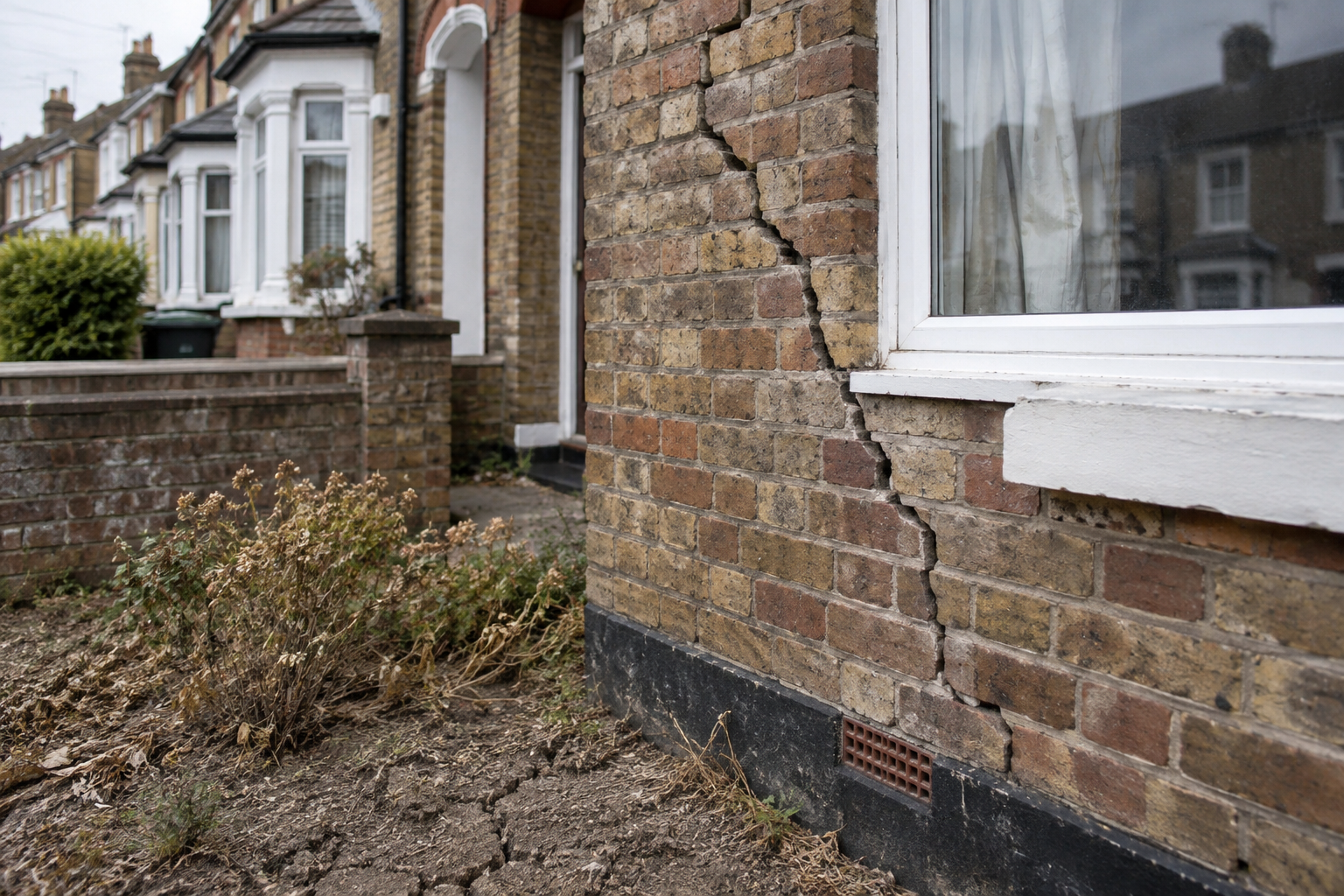
Warning signs listed in The Guardian’s report included diagonal cracks around doors and windows, particularly where they widen over time. Doors or windows that stick, uneven floors, rippling wallpaper and damp were also identified as possible signs. These are reasons to investigate a change in a building, not proof by themselves that its foundations are subsiding.
Aviva distinguished ordinary small cracks caused by shrinkage and movement after hot, dry weather from more concerning damage. It highlighted diagonal cracks wider than 2.5cm, roughly the diameter of a £1 coin, as a possible indication of subsidence. That example was not presented as a rule that narrower cracks, or other symptoms, can always be disregarded.
Read moreHome insurance premiums rose 31% in 2022–24, Commons research found
What people are saying
Hastings said some recent rain and a return to more normal temperatures had not removed its concern about continuing claims. At the time of the September report, it expected unusually high volumes to persist until around October unless sustained rainfall restored moisture in the soil. Its position was that a change in the weather did not necessarily mean the claims increase would stop immediately.
Charlie Inwood, the ABI’s general insurance policy adviser, also expected more subsidence claims in the months following the hot summer. His assessment concerned the likely direction of claims, rather than a forecast for their final annual number or value. The report did not provide an ABI estimate for total subsidence payouts across 2026.
Aviva said its subsidence claim numbers had increased in recent months and that the trend was likely to continue without significant rainfall. Its chief executive, Amanda Blanc, had said in August that the company was reviewing the reserves set aside for these claims. She also identified pricing models and exposure management as areas for review, but the report gave no resulting premium changes.
Axa expected a particularly busy year for subsidence claims but said it could not yet tell whether it would be a record. Adam Holland, head of retail underwriting, fraud and pricing governance at Axa’s UK business, linked the record summer temperatures to climate-related property damage. His comments were an expectation of further losses, not a confirmed year-end claims total.
What happens next
The immediate condition identified by both Hastings and Aviva was rainfall sufficient to relieve dry ground. Hastings’ forecast extended to around October, while Aviva did not specify an end date. As of 6 November 2026, the supplied September report does not establish whether either forecast proved correct, or whether claim numbers subsequently eased.
Aviva was also investigating measures homeowners could take to prevent damage from subsidence and flooding. The report did not set out findings from that work or announce a new prevention scheme. Nor did it provide a timetable for decisions arising from the insurer’s review of reserves, pricing and exposure.
For owners seeking cover, the reported increase in claims does not establish that every insurer will change its terms or refuse a property. Questions about an individual home remain separate from market-wide claims figures. The guide to online home insurance refusals and specialist cover examines why an unsuccessful online quotation does not necessarily settle whether insurance is available.
The source also gives no standard repair timetable for homes affected by this summer’s conditions. An insurer’s expectation that new claims may slow is different from a commitment to complete existing repairs. The separate report on West Acton residents seeking lasting subsidence repairs illustrates why the progress of an individual case needs to be considered separately from national claims trends.
Why this matters
For homeowners and buyers, the insurers’ figures show why changes in a building deserve attention without assuming that every crack means subsidence. The ABI’s £20,000 average claim indicates the financial scale of cases reaching insurers, but it cannot predict one home’s repair bill. Owners also need to distinguish forecasts about new claims from progress on existing damage. The September warnings did not establish when repairs would finish or whether individual insurance premiums would change.
Your questions answered
+Why did subsidence claims rise in summer 2026?
Hastings pointed to two unusually dry summers. Hot, dry conditions can shrink the ground beneath a house and move its foundations. The reported claims increase followed five heatwaves during the UK’s record-hot summer.
+How much did subsidence claims increase?
Hastings Direct said August 2026 claims were almost 140% higher than in August 2025. That figure covers Hastings’ business, not the whole UK insurance market.
+What is the average subsidence insurance claim?
The ABI said the average UK subsidence claim reached £20,000 between April and June 2026, more than £2,000 above a year earlier. An average claim is not an individual repair quotation.
+Which UK areas are most at risk of subsidence?
Scientists cited in the report identified London, Essex, Kent and a belt from Oxford towards the Wash among the more vulnerable areas. The report also identified older properties as more exposed.
+What are the signs of subsidence in a house?
Possible signs include widening diagonal cracks near doors or windows, sticking doors, uneven floors, rippling wallpaper and damp. Aviva said small movement cracks can also occur after hot, dry weather, so a crack alone does not confirm subsidence.
+Does rain stop subsidence claims?
Hastings and Aviva said sustained or significant rainfall could affect the continuing increase in claims. The September report does not establish what happened afterwards or give a date when existing damage would be repaired.
+Will home insurance premiums rise because of subsidence?
Aviva said it was reviewing pricing models alongside reserves and exposure management. The report did not announce resulting premium changes, so it does not establish how an individual homeowner’s renewal price would be affected.
This story draws on reporting first published by The Guardian.

Eleanor Whitfield, Property Correspondent
Eleanor covers the UK housing market, from monthly price indices to regional trends. She previously reported on business and economics for regional newspapers in Yorkshire and holds a degree in economics from the University of Leeds.