Glasgow Cathedral spire repairs tackle damage linked to rusting steel fixings
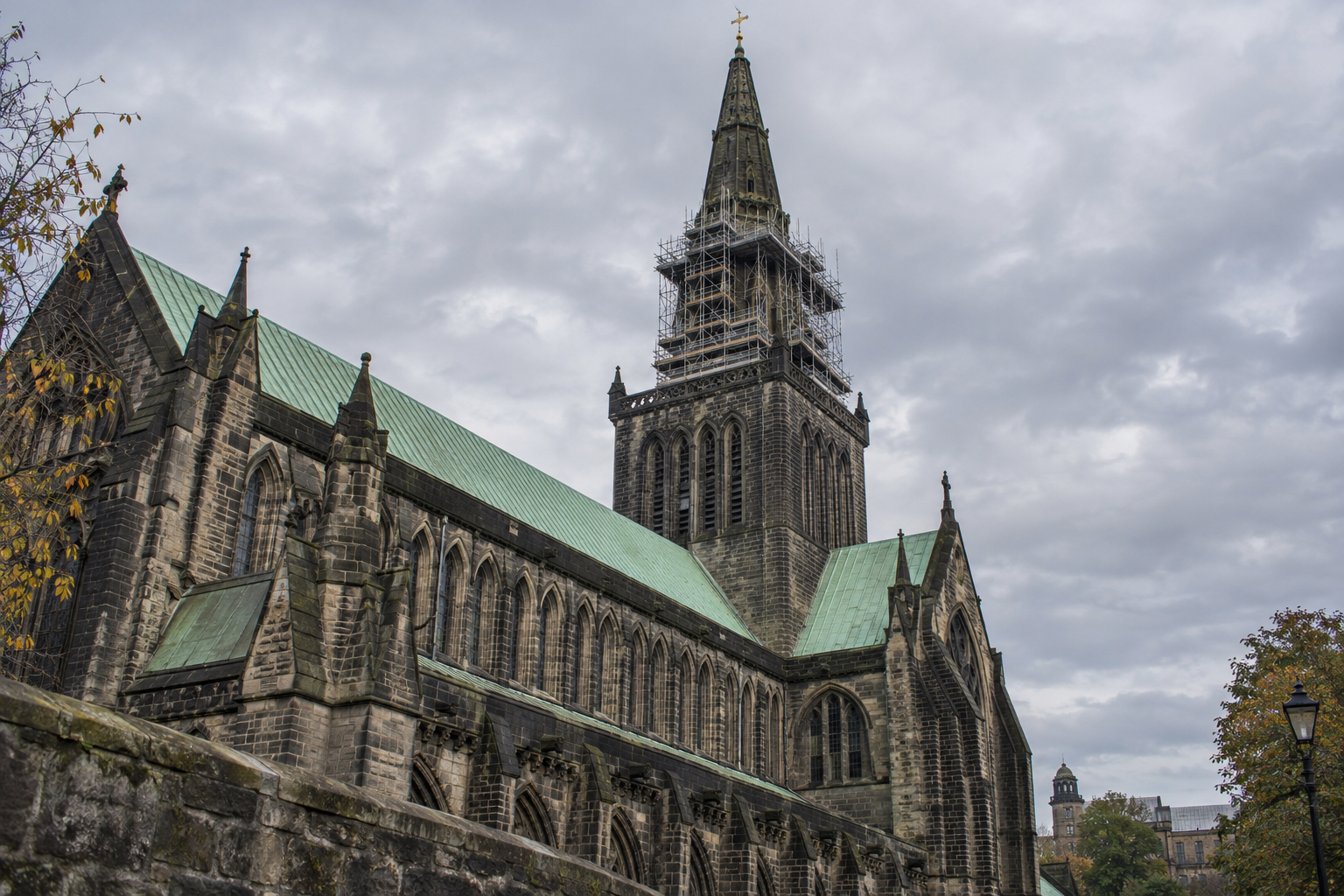
Glasgow Cathedral spire repairs will involve dismantling and rebuilding its upper section, with Historic Environment Scotland aiming to preserve as much medieval stonework as possible.
What happened
Glasgow Cathedral spire repairs have begun under a three-year Historic Environment Scotland (HES) programme to address damaged medieval masonry. HES says the upper section of the 225ft stone spire must be dismantled and rebuilt. The project will alter the cathedral’s appearance while conservation teams work high above its roof.
The intervention concerns the head of the spire, rather than the removal of the whole structure, according to HES. David Borthwick, its Head of South Region, said detailed surveys had established that taking down and reconstructing the upper section was necessary. Conservation work had already been taking place before that assessment.
HES traces the damage to bolts securing an internal steel frame fitted in 1970 to support the medieval stonework. As those fixings have corroded, they have exerted pressure against the surrounding masonry. The organisation says that pressure has produced both cracking and movement, making the earlier support system central to the current repair.
Increased rainfall has made the corrosion worse, according to HES. The organisation presents the damage as an example of the pressure that climate change places on Scotland’s historic buildings. Its announcement does not give rainfall measurements or quantify how much of the deterioration is attributable to changing weather.
HES stonemasons have already started carving stones to replace damaged material. Conservation teams intend to put back as much of the original medieval fabric as they can during reconstruction. That approach means the project combines new stone carving with the recovery and reuse of surviving historic masonry, rather than wholesale replacement.
The background
According to HES, Glasgow Cathedral is the city’s oldest building, with the present structure originating in the 12th century. Much of the building standing today comes from a substantial 13th-century rebuilding. It is dedicated to St Kentigern, who is also known as St Mungo.
The stone spire belongs to a later phase of construction. HES dates it to the 15th century and says it replaced a timber spire destroyed by lightning in 1406. The current repair therefore concerns masonry that has survived for centuries, alongside metal support introduced much more recently.
HES describes Glasgow Cathedral as the only medieval cathedral on mainland Scotland to have come through the Protestant Reformation of 1560 almost intact. Worship continued there after the Reformation. The cathedral remains a Church of Scotland parish church and, according to HES, also has a continuing civic and national role.
The 1970 frame adds another layer to that long building history: a modern intervention intended to support older fabric has itself become part of the repair problem. In general building terms, corrosion can cause embedded iron or steel to expand and damage surrounding masonry. The relevant lesson for older-property maintenance is to investigate how different materials interact, rather than assume a visible crack identifies its own cause.
Read moreScotland’s Places of Worship Fund opens with up to £1m for repair VAT
What people are saying
Borthwick said the decision to rebuild followed detailed investigation, rather than being the starting assumption for the project. He described the work as “challenging work”, involving traditional craftsmanship alongside modern conservation expertise. His stated priorities were retaining historic stone and helping the cathedral withstand a changing climate.
The specialist work includes both assessing the existing fabric and producing replacement masonry, according to HES. Those requirements connect with the wider issue of heritage skills gaps affecting repairs to Scotland’s older homes. HES has not, however, said that a shortage of craftspeople is delaying this cathedral programme.
HES has also appealed for people to keep off the scaffolding following recent incidents of unauthorised access. Borthwick said trespassing endangers those involved, interrupts conservation activity, draws staff away from their work and creates additional security costs. He asked anyone witnessing trespass, or holding information about the incidents, to contact Police Scotland.
HES identifies itself as Scotland’s lead body for the historic environment and says it cares for more than 300 nationally important properties. Its responsibilities also include investigating historic sites and understanding climate impacts on them. In this project, its public position brings together preservation of medieval material, safe working at height and the need to address weather-related deterioration.
What happens next
HES says the work will proceed in planned phases, with the sequence governed by suitable weather and safety requirements for working at height. The stated programme lasts three years, but the announcement supplied no precise start date or completion date. It would therefore be premature to attach a particular calendar deadline to the rebuild.
The planned physical sequence is to dismantle the upper section and then reconstruct it using retained historic fabric and replacement stones. HES has not set out how much masonry will need replacing or detailed the treatment of the internal steelwork. Those omissions leave important technical questions unanswered, without changing the stated reason for undertaking the work.
The announcement also does not specify visitor-access arrangements or any changes to worship during the project. Its statement that the cathedral continues as a parish church is not a detailed timetable for access around the works. Anyone planning a visit should check current arrangements directly rather than assume that all parts of the building remain accessible.
For owners considering repairs to older homes, the distinction between conserving existing fabric and replacing it has practical importance. As general UK context, work affecting a listed building’s special character may require listed building consent, even where ordinary planning permission is not needed. The separate case of Barn Close’s listing and protection of its Arts and Crafts interiors illustrates why internal features can matter alongside a building’s exterior; it is not evidence of the consent arrangements for Glasgow Cathedral.
HES’s announcement gives no overall project cost or breakdown of funding for the spire works. Separately, Scotland’s Places of Worship Fund offers support towards repair VAT, an issue relevant to the wider upkeep of religious buildings. Nothing in the cathedral announcement establishes that this programme receives support from that fund, and its budget should not be used as a guide to the cost of domestic stonework repairs.
Why this matters
For owners of older UK homes, the cathedral project shows why the cause of masonry damage matters as much as its visible symptoms. HES attributes the cracking to corroding fixings within an earlier support system, with rainfall worsening the problem. That does not diagnose cracks in other properties. It does underline the value of assessing the whole construction before choosing repairs, particularly where historic stonework, later alterations and exposure to rain interact.
Your questions answered
+Why is Glasgow Cathedral’s spire being repaired?
HES says bolts securing an internal steel frame have corroded and pressed against medieval stonework, causing cracks and movement. Detailed surveys showed that the upper section needs dismantling and rebuilding.
+How long will Glasgow Cathedral spire repairs take?
HES describes a three-year programme. Its announcement does not provide precise start or completion dates, and work will be organised around suitable weather and safety requirements.
+Is the whole Glasgow Cathedral spire being taken down?
No. HES says the head, or upper section, of the 225ft spire will be dismantled and rebuilt. The announcement does not describe removal of the entire spire.
+Will the original stones be reused?
HES intends to retain and reinstate as much original medieval material as possible. Its stonemasons have already begun carving replacement stones, but no replacement quantity has been published in the announcement.
+Has climate change damaged Glasgow Cathedral?
HES says increased rainfall has worsened corrosion in the spire and links this to growing climate pressures on historic buildings. The announcement does not quantify the contribution of changing weather to the damage.
+Can you visit Glasgow Cathedral during the repairs?
The announcement does not set out visitor-access arrangements during the works. Check current arrangements directly before travelling, and stay off the scaffolding.
+How much will Glasgow Cathedral’s spire repairs cost?
HES has not given an overall project cost or funding breakdown in this announcement.
+What should I do if someone climbs the cathedral scaffolding?
HES asks anyone witnessing trespass, or with information about recent incidents, to contact Police Scotland. It says unauthorised access is dangerous and disrupts conservation work.
This story draws on reporting first published by Historic Environment Scotland News.

Robert Ashdown, Period Property Specialist
Robert writes about caring for older, listed and period homes, including damp, structural movement and conservation rules. He has reported on heritage and housing for over fifteen years.